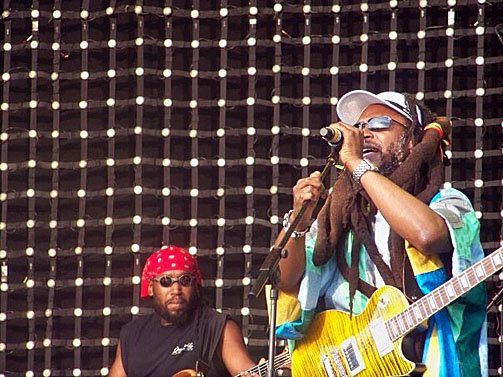
 Steel Pulse's David Hinds
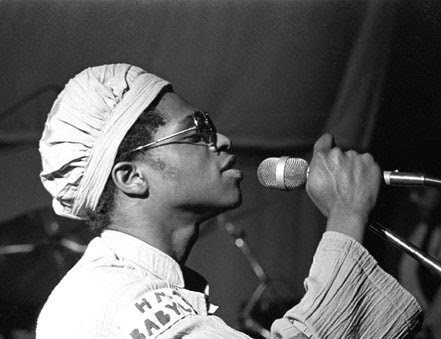
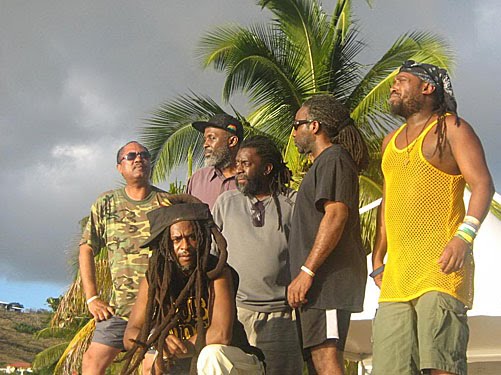
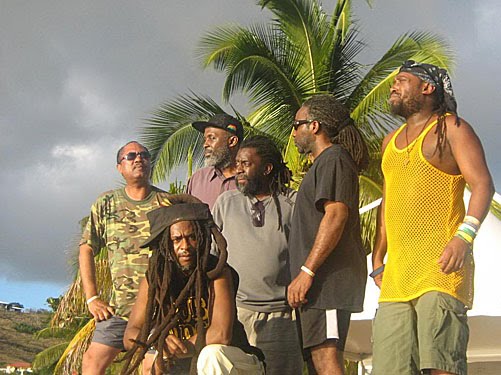
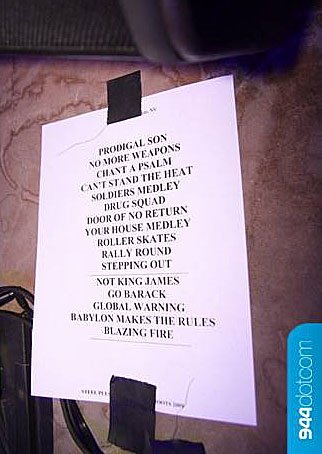
play one of their rare UK live dates tomorrow night (Wednesday 27 May) at London's Shepherd's Bush Empire as part of the Island Records 50th Anniversary, having just completed a short tour of the United States. Steel Pulse will be back playing live in the UK at the Glastonbury Festival on 26 June. Lead singer and songwriter David Hinds has been in the press recently to coincide with the US tour dates and here's a couple of on-line interviews with the man himself.
Lend Him an Ear -
written by Damian Orion (Good Times Weekly)Joni Mitchell once flung a memorable quip at some audience members who were shouting out requests for her hits: “You know, a painter does a painting, and that’s it. He’s had the joy of creating it ... No one ever said to Van Gogh, ‘Paint another “Starry Night” again, man!’” David Hinds, vocalist/guitarist/songwriter for the veteran reggae outfit Steel Pulse, would surely be able to relate to Mitchell’s lament. Having been making the rounds with Steel Pulse for more than three decades, Hinds can’t be faulted for wanting to explore new musical terrain with his bandmates, but he finds himself somewhat held back by his obligation to slake his fans’ thirst for classics like Ku Klux Klan, Worth His Weight in Gold and Bodyguard. “When we go to places like France and certain parts of the Caribbean where our market’s pretty strong, and certain parts of Europe as well as the U.S., we find that no matter what we play, they still want to hear the traditional reggae stuff from us,” the Birmingham-born musician explains. “When we’ve dabbled in dancehall and featured acts like Capleton and Damian Marley, the general complaint of the fans is that they want to hear us in the way they were introduced to us in the first place.”
Hinds readily acknowledges that his predicament is not a unique one. “I’m sure it plagued Hendrix; I’m sure it plagued Vincent Van Gogh; I’m sure it plagued Wolfgang Amadeus Mozart,” he states. “You want to move on and do other things, but how you’ve been introduced to the world in the first place is the way they want to see you. And then when you’ve died, and the word ‘R.I.P.’ is on your tombstone a hundred years later, people say, ‘Wow! That was far out! Is this what he was trying to do?’”Though Hinds’ quest for musical expansion has led him to flirt with everything from R&B to pop over the years, his lyrical content has remained fairly consistent since Steel Pulse’s inception in 1975: This is, in essence, a protest band, with racism right at the top of the list of sociopolitical issues being addressed. Hinds points to various visa, passport and immigration complications as well as to the discovery of nooses on a tree in Jena, Lousiana in 2007 as examples of the lingering presence of racism in the world. Nonetheless, anthems like “Ku Klux Klan are happily a tad less relevant today than in 1975. “We’ve still got a long way to go, but I do see a progression,” Hinds offers. “I didn’t think Nelson Mandela would have been released or a black president in the United States would have happened in my lifetime. But having said that, George Bush played a remarkable role in making that happen. He had to be so bad a president that they had to look in the direction of a black man!”
The singer, who notes that this year marks the 80th birthday of Martin Luther King, adds that all throughout his childhood in England, he observed hostility between people who came from the Caribbean and people who came from India or Pakistan. “Now, when you see an Asian person in a BMW with the windows down, and reggae music is blazing at 200 decibels, it’ll show you that there is an understanding of cultures,” he says. Hinds feels that reggae music has been instrumental in helping break down cultural barriers. “When I go to rock concerts, I see white folks,” he states. “I go to an R&B concert, I see mostly black folks. You go to a reggae concert, and you see all kinds of people there from all kinds of walks of life, whether it’s someone with a tie pushing a pen in his office or someone who’s got his pants half around his ankles, doing the bop. They’re all there, chuggin’ around to reggae music.”
Steel in The Game - by Curtis Cartier (MetroActive)
It's tour time for Steel Pulse. Plane tickets have been booked, backup singers hired and hotel reservations made. David Hinds is in Birmingham, England. In less than two weeks, he'll be in San Francisco, kicking off the latest leg of the tour. But after 35 years as frontman for the iconic roots-reggae set, he's got the process down to a science and is a sea of calm amid the last-minute preparations. "I'm really looking forward to coming to Santa Cruz again," he says of his May 6 gig at the Catalyst. "I've been there a million times, and I always love coming back." Hinds' excitement seems genuine; his cultured Birmingham British accent only slightly marred by occasional dips into the London cockney. The giddiness is refreshing, given the sour outlook many musicians possess after decades of records, gigs and interviews. For Hinds, despite watching 12 members, including four founders, quit, wash out or move on, and despite bitter fallouts with three major record labels, touring is still a time when it's all about the music. "It's always been a struggle," he says. "A lot of people still don't get what we're trying to do, you know. But on the road we can just concentrate on the music."
Steel Pulse, however, has never been only about the music. From the group's first record, Handsworth Revolution, in 1978 to its latest, African Holocaust, in 2004, a rebellious political spirit and a fundamental Rastafarian message have permeated the substance of both music and musicians. And though the group now sits comfortably as the most successful reggae act to come out of the U.K., it's been a long fight to get here. "Reggae music came to the U.K. from people like us - children of immigrants who migrated after the war," says Hinds. "Back then, our music was never taken seriously. We were black Britons and we were used to getting the racial slurs in school. Venues didn't want to play us because we had a protest message." Hinds describes the mid-'70s as one of the most trying times for his young band. A strange thing happened in the late '70s and '80s in London, however, and reggae music soon found itself championed by unlikely supporters. "Punk rock came along around then. The punk rockers were interested in supporting anything that the system was opposing. And at that time, the system was definitely opposing reggae music," Hinds explains. "We were never really into punk but we started to realize the similarities between reggae and punk and started playing with a lot of the bands."
Fast-forward to the present and punk rock is all but dead. Reggae, with the passing of its prince Bob Marley in 1981, might have died also, but thanks to acts like Steel Pulse, Buju Banton, Junior Reid and the Wailing Souls, roots reggae can be now heard everywhere from head shops to supermarkets. Hinds says he's thankful for the longevity of his music and the increasing demand, but at times, he's still surprised by it. "As far as the media was concerned, when Marley died the music was over. That wasn't so," says hinds, his voice quickening. "People tried all kinds of new subject matters and styles to keep up the popularity. They started drifting away from the spirituality. But we've always been about deeper things, you know." It's these "deeper things" that Hinds says Elektra, MCA and Atlantic record companies could never understand. Those companies "turned their backs on us, so we turned our backs on them," according to Hinds, and today Steel Pulse is represented by the small, reggae-only, RAS label. "Every time reggae bands were signed to a major label they were thrown into the black category or R&B. We never saw any of the money they promised," he says. "Now with the Internet and pirate radio stations, we get more exposure than we did with the major labels."
In Santa Cruz, Steel Pulse has had plenty of exposure. Hinds says the town is always a must-stop on any American tour, and with tickets expected to sell out, it's clear that local fans feel the same way. "The people in Santa Cruz have been wonderful to us over the years," He says. "We feel deeply indebted to everyone there. Thanks for all the love."
Labels: Steel Pulse
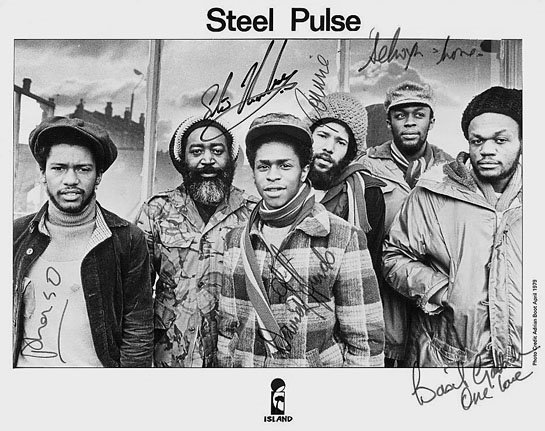
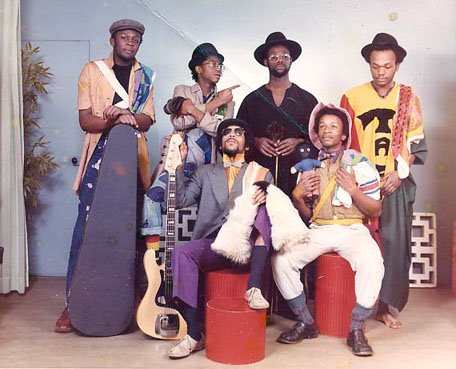
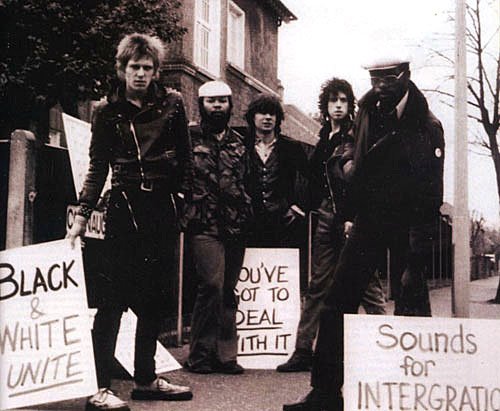
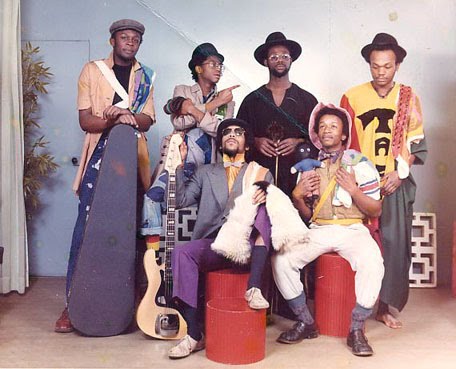 Steel Pulse in all their early 1975 glory. LtoR: Selwyn Brown, David Hinds, Michael Riley, Basil Gabbidon; [front row] Ronnie McQueen, Colin Gabbidon.