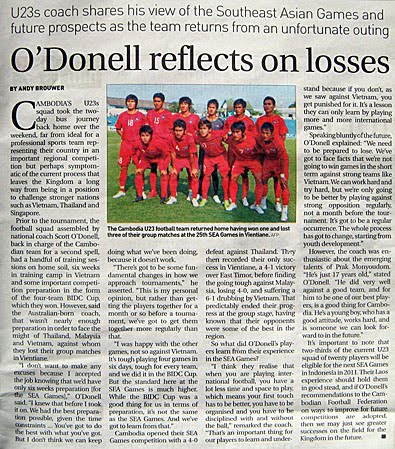
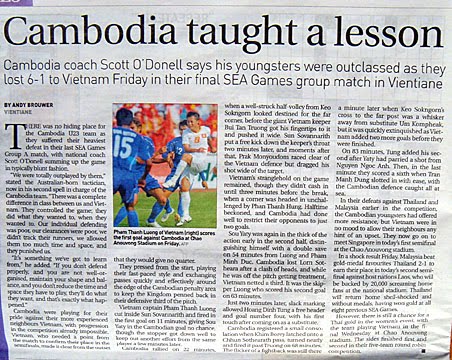
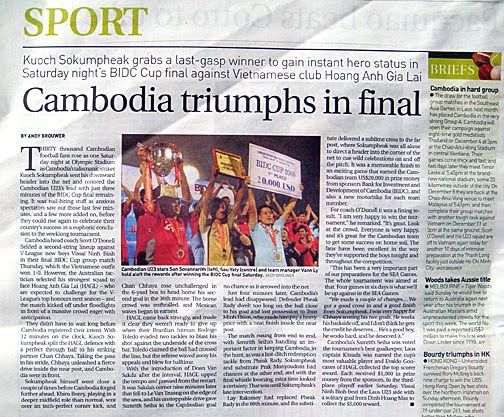
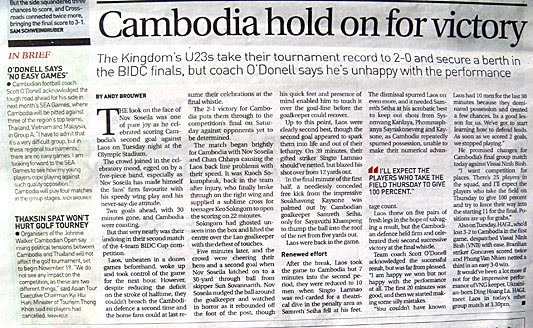
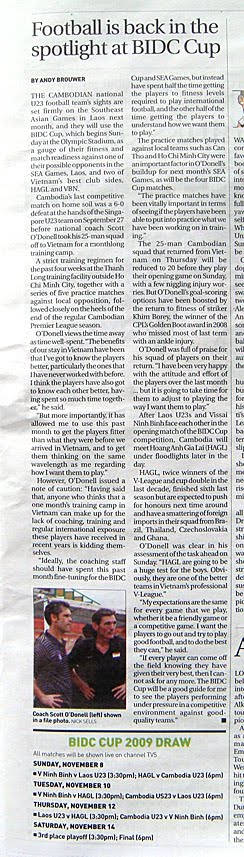
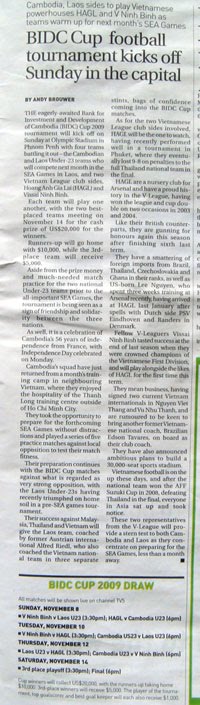
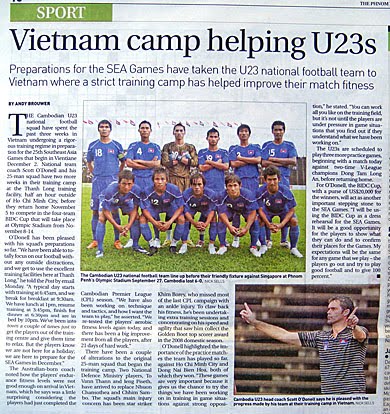
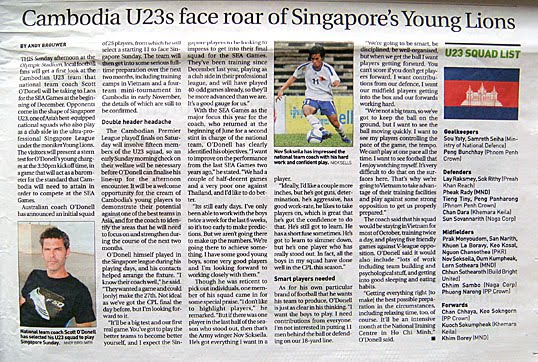
So you can keep up to date, on-line, with my Phnom Penh Post articles, here's a link to three of my mine that are in today's paper, as well as the articles reprinted below.
U23 spirits high in Vientiane hereO'Donell happy with accommodation in Laos hereTournament favourites aim for SEA Games final here.
U23 spirits high in Vientiane
The Cambodian U23 national team remain focused and confident ahead of their SEA Games opening match Friday against eight-time gold medalists Thailand.
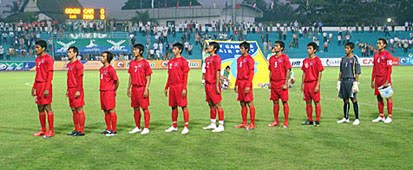
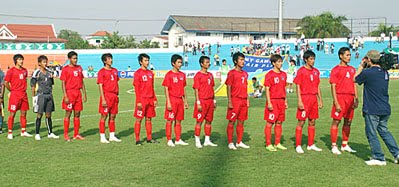
We are just a day away from the Cambodian U23 national team’s opening match as they fly the flag for their country at the 25th Southeast Asian Games in Vientiane. Football is the first competition to begin at the Games, and the Cambodian players arrived in the Athletes Village Sunday evening, after a tough two-day overland journey from Phnom Penh. Drawn in Group A alongside the heavily fancied Thailand, Vietnam and Malaysia, and also East Timor, everyone has already written off Cambodia’s chances of progressing. Instead the opening game of Group A, Thailand against Vietnam, is expected to be the composition of the final on December 17. That’s assuming, of course, that Cambodia will roll over and provide the expected easy pickings for the higher-ranked teams, though anyone who witnessed the performance levels of the Cambodian team in the recent BIDC Cup tournament in Phnom Penh may have other ideas, and that includes the players themselves.
Thailand, the SEA Games football champions for the last eight competitions, will provide the opposition in Cambodia’s first game Friday. For an opening match, they don’t come any harder, but there’s a real strength of character and resilience about the Cambodian team under Scott O’Donell’s stewardship, and the players are determined to carry on the high standards they set themselves in the BIDC Cup. Victories over V-Leaguers HAGL (twice) and Laos U23s gave the Cambodian team a huge confidence boost after their first match under O’Donell ended in a 6-0 drubbing by Singapore. Capturing the BIDC Cup in front of 30,000 of their own ecstatic supporters has breathed a sense of purpose and pride into the young Cambodians, and six weeks’ intensive training in Vietnam has only served to cement that collective unity.
Reflecting on their BIDC success, Cambodia’s captain, Sun Sovannarith spoke for his teammates when he said: “I felt so happy that we won and proud that the team’s performance has improved so much. The victory has given us great confidence for the SEA Games.” The scorer of the winning goal in the BIDC Cup final was popular striker Kuoch Sokumpheak, and he too expressed his pleasure. “I was very happy when I scored the winning goal. I felt happy for myself and felt proud for my country. I think the victory lifted the soul of the nation because of our football success.” His strike partner, and one of the youngest players in the squad, Keo Sokngorn was equally upbeat. “For Cambodia to win, it made me so happy that we became champions of the BIDC Cup,” he stated. “All our players played very hard and very well. And it felt good to play in front of so many people at the Olympic Stadium.”
That was then, and this is now as Cambodia prepare to face a Thai team under the direction of Englishman Steve Darby, who is assistant to national team boss Bryan Robson. Expectation is high that the nation will add another SEA Games gold medal to their collection, but try telling that to the Cambodian players. “Thailand, Vietnam and Malaysia are all good teams but I don’t worry about playing against them,” remarked teenage Keo Sokngorn, who is also the captain of the national U17 team. “All I know is that I will play hard and my best. I want to win.” Kouch Sokumpheak is similarly focused ahead of Friday. “I won’t say we will win, but I will try my best and I really want to score goals against Thailand for my country,” he asserted.
The final word goes to the captain, Sun Sovannarith, who missed the birth of his first child, a girl, on Monday because of his involvement in the SEA Games. “The difference between us and Thailand is that they are big and they understand each other very well, as they play together for a long time,” he noted. “They have more experience and they play in a very good, strong league in Thailand. Win or lose, I don’t know, but I will fight 100 percent for my country until I die.” That sense of passion and determination could just provide an upset to the competition’s hot favourites on Friday.
O'Donell happy with accommodation in LaosCambodia U23s coach Scott O’Donell has no complaints about the conditions at the players’ village in Vientiane.
The four group matches that Cambodia will play at the Southeast Asian Games will determine their success or otherwise, but it’s the off-the-field facilities that can be just as important to put the players in the right frame of mind before competition. Scott O’Donell, the Cambodian coach, was in charge of the team for their last SEA Games outing in Khorat, Thailand, in 2007. “The rooms at the Village are a lot better than at the last Games in Khorat,” he noted. “At least we don’t have communal showers and toilets this time around. The Village isn’t fully operational yet because the Games don’t officially open ’til later, but the food’s OK, no complaints on that score, and the accommodation is OK too, and that’s what’s important for us.”
“It would be nice to have something to keep the players occupied in their free time,” he added. “In Khorat we had a games room and Internet. Here we have nothing like that, but it’s the same for every team. At least there’s a medical room, which is good, as some of the boys have been getting some physiotherapy.” The right diet and looking after themselves is a part of the players’ preparation that O’Donell has been keen to stress. “The food is good, a wide variety, and it’s nice,” he reported. “There’s pasta, rice and veggies, and all the boys are getting stuck in. They are starting to realise the importance of their diet, and they get a lot of fruit and veggies here, which is a good thing. I’m happy with it.”
The national coach claimed that, so far, the training facilities have been a mixed bag. “The first training session at the army stadium was fine. The next two at the television facility were absolutely terrible and simply not good enough. And today was perfect. So a mix of good and bad,” he commented as the team ended their first session at the Chao Anouvong Stadium, in central Vientiane where they will play three of their four group matches. The Cambodian team watched both of the football competition's opening games Wednesday and trained for an hour Thursday morning before making their final preparations for their first match against Thailand at 3pm Friday.
Tournament favourites aim for SEA Games final Regional football powerhouses Thailand and Vietnam drew their opening SEA Games football match 1-1 Wednesday night in Laos.
The pundits’ favourites to reach the final of the Southeast Asian Games football tournament, Vietnam and Thailand, have been given an added financial incentive to do well in the region’s top competition. Sponsors AVG have offered Vietnam’s squad prize money of US$200,000 if they win the gold medal, and half that if they pick up silver. Thailand have also been offered a big cash incentive of $170,000 to repeat their SEA Games successes of previous years. The two teams met in the opening round of matches Wednesday night at the brand new National Stadium, just outside Vientiane. A tense match saw Thailand take the lead in the 70th minute through Kirati Keawsombut, only for Vietnam to grab a last minute equaliser by Hoang Dinh Tung from the penalty spot.
Thailand have won the gold medal on the last eight occasions and are on course to repeat that feat, according to their coach, Englishman Steve Darby. “I have selected the team myself,” he stated. “I know Thailand take the SEA Games seriously, and we have a good squad. We will try to do our best to bring the gold medal back to Thailand. “Our players are excellent and their attitude is excellent. Obviously, Vietnam are strong too. We will play them first and hopefully we play them last. We will go out and try to win every game. That is a magic formula in football. You have to be self-confident and confidence is very important. We want to be confident without arrogance.”
Thailand beat Sri Lanka 2-0 in their final warm-up match before arriving in Laos. “The shape of the team now is very good,” affirmed Darby. “We had some useful warm-up matches and showed good form against Sri Lanka. The team has great potential and have garnered some good experience after playing in the Thai Premier League. “Only the goalkeeper didn’t play in the Thai Premier League last season. But he is a U19 international player. He is a great athlete, a great goalkeeper,” Darby said of Ukrit Wongmeena, who is on the books of Thai champions Muang Thong United. Darby also commented on his squad selection. “Everybody will pick a different team – that is football. Everyone will pick 20 different players. I have to make the decision based on what I think is best, I get paid for that. I listened to leading Thai coaches and international coaches and basically, they are very happy with the squad.” The Thai side is captained by defender Kiatprawut Sawaeo, one of the players who is also in the full national team along with striker Teerasil Dangda. Seven of the squad played in the successful SEA Games team that captured the gold medal in Khorat, Thailand, in 2007, with seven players coming from TPL club Chonburi and four from champions Muang Thong.
Vietnam had arrived at the SEA Games Village a day before everyone else, in order to get themselves settled in and into the right mindset. Their Portuguese coach Henrique Calisto has chosen his squad with this and the next SEA Games in mind, giving a preference to players young enough to compete in both. That has meant a handful of star names will be missing including defender Cao Cuong, a cornerstone in Danang’s V-League success year, as well as talented midfielder Van Khai, who plays for Calisto’s club side, Dong Tam Long An. “In football, there is no place for sentimentality,” said the national coach. “It is very difficult for me to choose and cut players … I wanted to ensure that our younger players have a chance to play and improve at the next SEA Games in two years.…Five of the seven cut players are good enough to join the U23 national team,” he continued. “I feel sorry for them, but we have to obey the rules. They are as good as the chosen players but the youngsters must be given a chance to advance because they are the future of the national team.” In the current Vietnam squad, only three players have previous SEA Games experience.
The match up between Thailand and Vietnam was preceded by two other teams from Group A, Malaysia against the minnows of Timor Leste. Indeed, the Timorese were made to feel very small by a rampant Malaysia that knocked in six in the first half, and five more in the second, to end the game 11-0. No less than eight different names made it on the scoresheet for Malaysia, with Ahmad Fakri Saarani netting a hat trick.
Labels: Cambodian U23s, Phnom Penh Post, SEA Games