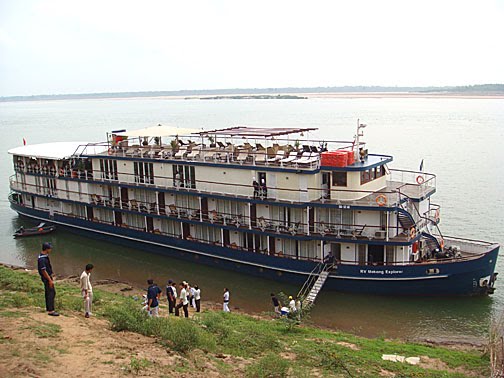
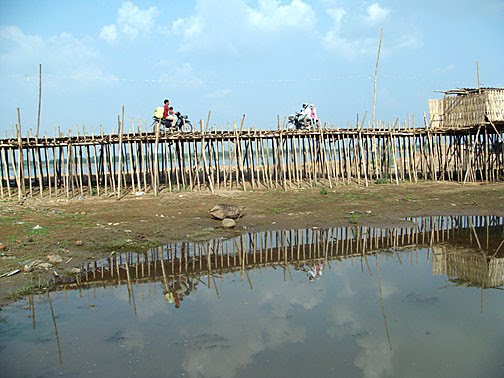
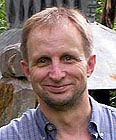
If you see me and I have a worried frown on my face, it's because I am attempting to follow the instructions of blogger.com as I have to amend the location of my blog hosting. Blogger.com are no longer allowing FTP publishing and I must migrate my blog before 1 May. They have provided an online migration tool but when you are a technophobe like me and have a large blog, going back to May 2006 with thousands of posts, you begin to break out in a cold sweat at the mere thought of doing anything which might make a total balls-up of it. And with my history with blogs - don't forget I had my blog stolen a couple of years ago - anything could happen. I'm migrating tonight so if you don't hear from me tomorrow via this blog, then something may've gone tits-up. Wish me luck.
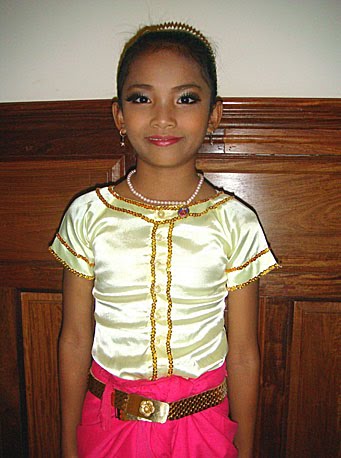
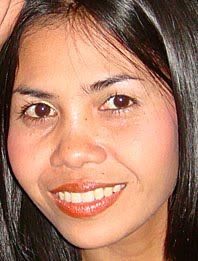
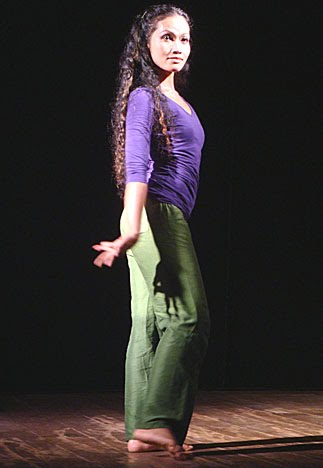
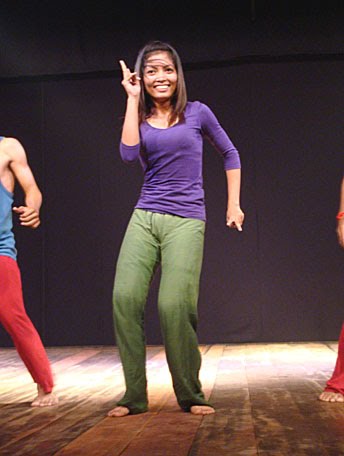
The absolutely adorable Chamreun, from the COFCO dance troupe
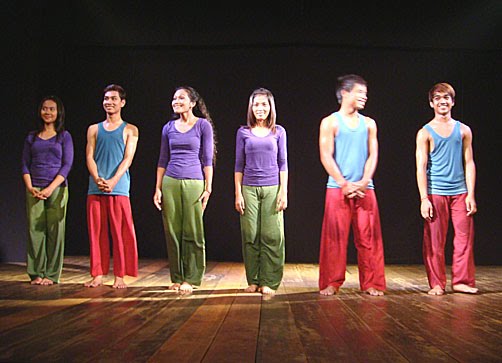
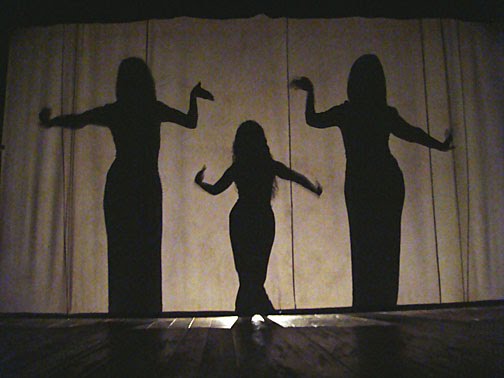
In case you are in Siem Reap on any Friday evening and enjoy a spot of Cambodian folk and classical dance demonstrated by some talented youngsters, then get along to the Shadow of Angkor guesthouse, along the riverside and around the corner from the Old Market. My friends at the Shadow are giving a platform to the orphans from COFCO to perform each week at 6.30pm, with a BBQ buffet if you fancy it, and donations are gratefully received, going direct to the orphanage for the benefit of the children. I recommend you join in the fun. I saw them in March and the COFCO kids are pretty talented.
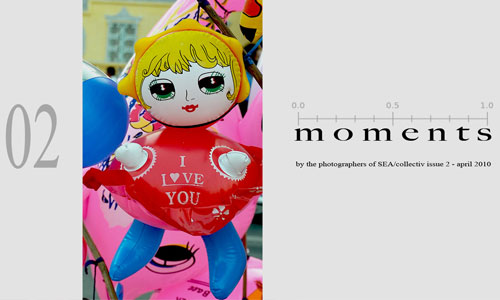
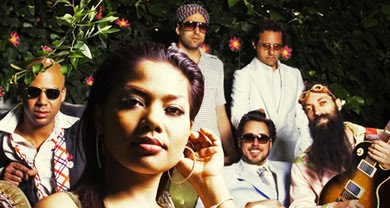
Moments, the e-zine from the photographers known as the SEA/collective, has its second edition out now, here. The e-zine has a wide range of photographic subjects for your viewing pleasure and news that the group will be working with Dengue Fever on their upcoming visit to the Kingdom for a couple of shows in Phnom Penh. They will also have their own group exhibition at Chinese House in the city in July. Stay tuned for more on both projects.
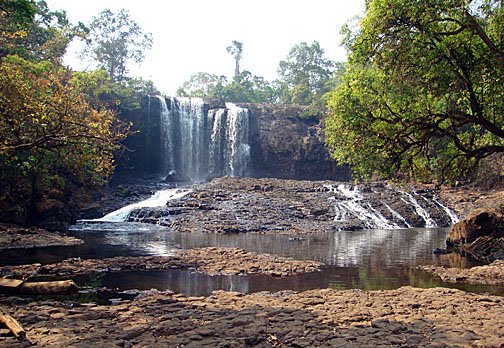
Bousra waterfall in Mondulkiri - regarded by many as the country's best
As the police crackdown on riverside restaurants and their outdoor seating in Phnom Penh - there's always something for the police to crackdown on, crime might be a good one to begin with rather than removing pot-plants and the odd chair and table - there's news that the company who were developing/ruining Mondulkiri's best tourist feature, Bousra waterfall, are pulling the plug on the $6million ecotourism project (that included hotels, restaurants and shops surrounding the attraction) due to lack of funds. Maybe someone will stop cutting down all the trees now. Fat chance. Talking of ecotourism projects, I'm off on a fam trip jolly next week, courtesy of Cambodia MSME and USAid. It's for tour operators to have a good look at a few community-based projects, namely Chambok, Anlung Rath, Peam Krasaop in Koh Kong, Tatai Krom and Chi Phat, with the desire that we will offer up our professional advice and promote these projects to our clients. This is a follow-up from the Hidden Treasures Cambodia contest that was run last year and which included these and many more community-based initiatives.
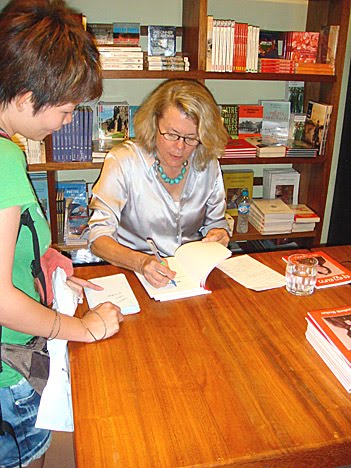
Elizabeth Becker signing copies of her new book Bophana at Monument Books
A who's who of names graced the book launch of Bophana, the latest release from acclaimed former New York Times journalist Elizabeth Becker, at Monument Books earlier this evening. A short speech and questions & answers by Becker was already over by the time I arrived at Monument, having been slow to get away from the football at Olympic Stadium. As I entered the bookshop and saw the massive turnout, I spied Mu Sochua and Roland Eng and knew the heavyweights were out for this particular publication. A mere 83 pages in length, printed in three languages and costing $8, with some of the profits going towards the Harpswell Foundation, Bophana has been published by The Cambodia Daily Press and describes the life of this Khmer heroine as well as Becker's desire to bring her story to a wider audience. Bophana does just that.
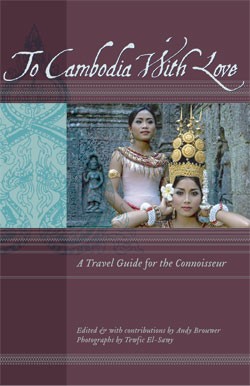
With all these book launches taking place, I must insert a shameless plug for my own book, which with a fair wind and uninterrupted shipping (knowing my luck, the book's shipment will be impounded by customs), should be out and about in June. Well, that's the last publication date I heard but nothing is certain in the world of books, so stayed tuned. The book is titled To Cambodia With Love, published by ThingsAsian Press, and will contain over 125 essays from more than 60 people who have a passion for this wonderful country. I'm just the co-ordinator, editor, chapter introducer, general dogsbody for the book, the real meaty stuff will come from my fellow contributors who like me, share a deep love for Cambodia. If William at Monument Books can fit us into his busy book launch schedule, we might even get our five minutes in the spotlight, where I will encourage/threaten you to buy the book. I had an interesting email recently that informed me that the dancer adjusting her crown on the front cover of the book is named Peow, and that she still dances for the Komar Angkor dance troupe in Siem Reap. The original photograph was taken by the Tewfic El-Sawy, who took all the pictures that will appear in the book. He's a freelance photographer who specializes in documenting endangered cultures and traditional life in Asia, Latin America and Africa.
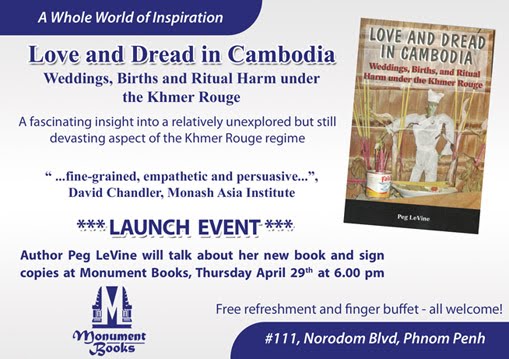
Monument Books in Phnom Penh are going book launch crazy. They are hosting Elizabeth Becker's new book, Bophana, tomorrow (Saturday) night and then follow that up with Peg LeVine's Love and Dread in Cambodia next Thursday (29 April) at 6pm. Hats off to Monument Books. For Becker, she first told the Bophana love story in her excellent book When The War Was Over and this latest version is published with The Cambodia Daily and available in English, French and Khmer languages. This is a must buy book showing the strength of love under extreme circumstances. For Peg LeVine, she spent a decade researching forced marriages and births under the Khmer Rouge and the traumatic impact this had on so many. Love and Dread in Cambodia: Weddings, Births and Ritual Harm under the Khmer Rouge is published by NUS Press Singapore.
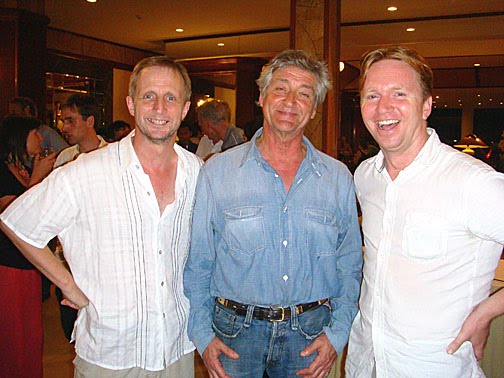
Jon Swain (center) flanked by two hangers-on, myself (left) and Nick Ray (right)
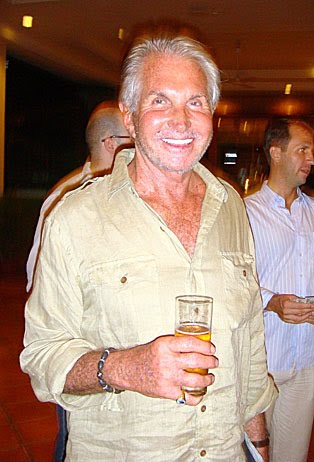
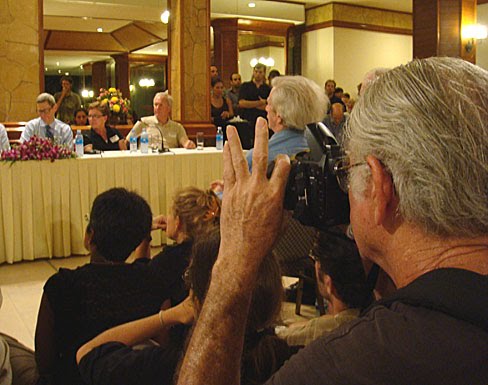
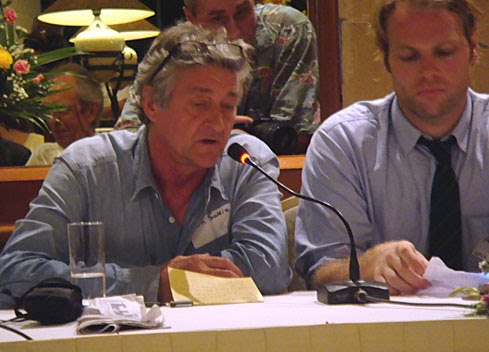
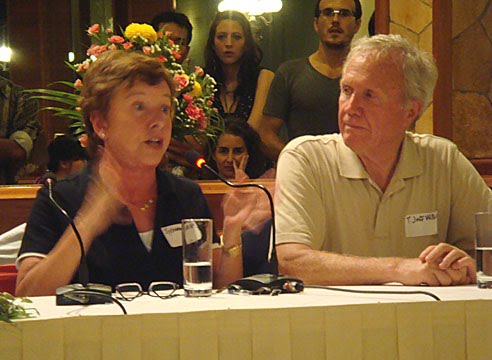
It was sweltering hot, the pa system was inadequate and the organisers were completely unprepared for the huge turnout, and to be honest the panel session could've gone on into the wee hours, the interest was that high. The war correspondents from the late 60s and 70s were out in full force with Al Rockoff snapping merrily away as Jon Swain, Sylvana Foa, Dan Southerland and T Jeff Williams regaled us with their memories, paying particular emphasis to the gung-ho style of reporting in those days and the not to be forgotten contribution from their Cambodian fixers and fellow journalists. Tim Page stood up at the end to announce that the remains recovered recently did not belong to his friend Sean Flynn, George Hamilton, the suave, tanned actor from Hollywood was on hand to lend the event some kudos, but it was the incredibly large turnout that caught everyone by surprise and almost turned the night into a shambles. It was rescued but only just. Jon Swain and Elizabeth Becker graciously signed copies of their excellent books, River of Time and When The War Was Over, which have been in my possession for 15 and 20 years respectively. Nice people.
Three of the war correspondents at tonight's event, Jon Swain, Elizabeth Becker (center) and Sylvana Foa
My camera flash has managed to rob actor George Hamilton of his trademark golden tan - sorry George.
Veteran photographer Al Rockoff (right) snapping away at tonight's event
Jon Swain telling the packed audience of his memories of Phnom Penh
The animated Sylvana Foa and the more restrained T Jeff Williams at tonight's panel discussion
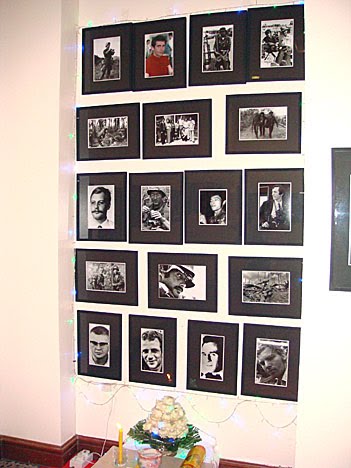
A wall of photos of the journalists who were killed or are MIA from the Cambodia conflict
If you have read Elizabeth Becker's acclaimed book, When The War Was Over, or watched the documentary by Rithy Panh that's played a couple of times each day at Tuol Sleng, you'll be aware of the story of Huot Bophana. Her love letters to her husband were found in her S-21 file and was a story that first captured the imagination of Becker and many others since. In her new book Bophana, the award-winning author and journalist, takes us closer to the main characters in this love story in the time of war. Elizabeth Becker has covered national and international affairs as a Washington correspondent at The New York Times, the Senior Foreign Editor at National Public Radio and a Washington Post correspondent. She began her career as a war reporter in Cambodia in 1972 and was one of only two journalists to visit Cambodia and interview Pol Pot while he was in power. She will be at Monument Books this Saturday (6pm) to launch her latest offering. website
I can't make the football match this afternoon, the first I've missed this season, as I've had severe stomach cramps all morning and caution is the key word, rather than spending a few hours at the Olympic Stadium with its less than rudimentary toilet facilities. Oh, and it looks like rain, which belted down for an hour yesterday lunchtime and flooded the whole city. I've still got a chest cough, that's been hanging about like a bad smell for over a week now, so all in all, I'm doing the usual manly thing and feeling very sorry for myself. No-one else could care less. Added to that, my cleaner Det, who is excellent, has handed in her notice and will be leaving next week. Damn, damn, damn. Cycling to my house three times a week is not doing her weak heart any good she tells me. Ah, okay then, good point. She's the 5th cleaner I've had in the last three years and they've all been especially good. My female friends say I should get married so my wife can look after me, which is the usual course of advice anytime I'm under the weather. Four of them have offered, but I'm not sure if that's to be my cleaner, or to be my wife!
Have I whinged about the state of the Cambodian post system recently? Because I've just had a delivery to my office from the main post office in Phnom Penh of three large envelopes which contained books and stuff sent to me in early February. It's now close to the end of April and frankly, the service is crap. Though at least this time the envelopes hadn't been opened. So what did the postie bring you might ask? Two books from Demaz Baker, namely her A Taste of Cambodian Cuisine, a Khmer cookbook of ingredients and recipes, which she uses in the cooking classes she teaches; and Khmer Legends, seventeen folk tales from her homeland including the story of Wat Nokor and Phnom Pros Phnom Srey (Man and Woman Mountain). From James Rosin came his look back at the classic cult sci-fi television series in the late 60s called The Invaders, which was a big favourite of mine with David Vincent doing his best to warn the world of the invasion of aliens. Okay, you had to suspend belief and the invaders were recognisable by their distorted pinky finger but that was part of the fun. The final envelope contained a DVD of excerpts from Sarah O'Brien's new musical, Winds of Angkor, which she hopes to premiere in Cambodia in the not too distant future. She also sent me a book of images from the musical. My grateful thanks to all three. I also need to get out to Monument Books sometime soon, as I have a list of books that are missing from my library of Cambodia publications and that needs to be addressed.
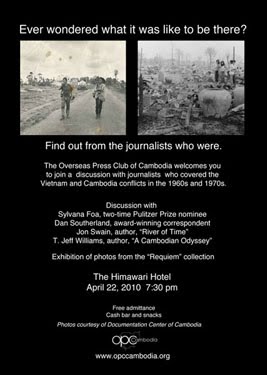
This week sees a reunion in Phnom Penh of some two dozen surviving veteran journalists, photographers and cameramen who covered the conflict in Cambodia and Vietnam in the 60s and 70s. After a few days in the city they will continue their reunion in Saigon. Part of the Phnom Penh activities will be to dedicate a memorial to journalists killed in war. Among those expected to attend are author Elizabeth Becker, Tim Page, Kurt Volkert, Jacques Leslie, Martin Stuart Fox, Perry Deane Young, Don Kirk and Al Rockoff. A total of 37 international and Cambodian journalists were killed or went missing-in-action in Cambodia between April 1970 and April 1975. The largest number were from Japan (10), France (8) and USA (7). The most famous of the MIA are Sean Flynn and Dana Stone who disappeared at Chi Phou on 6 April 1970. One rather less well-known story is that of Khmer journo Ly Eng who hid in the Monorom Hotel for two or three weeks after the Khmer Rouge entered Phnom Penh on 17 April 1975. He came out of his hiding place, found his old red convertible sports car and drove down Monivong Boulevard towards the bridge, breaking through a few Khmer Rouge barricades. He reached the bridge but a group of Khmer Rouge guards sprayed him with bullets and he plunged into the river with his car. As part of the activities a panel discussion with 4 of the journalists who covered the conflict, will take place at the Himawari Hotel this Thursday, 22 April, at 7.30pm (free admission). The panel includes Sunday Times correspondent, Jon Swain, author of one of my favourite books, A River of Time, chronicling his experiences in Indochina, including the fall of Phnom Penh in 1975. Also T Jeff Williams is on the panel, he co-authored the book, A Cambodian Odyssey and the Deaths of 25 Journalists with Kurt Volkert.
A panel discussion is set for this Thursday, 22 April at 7.30pm
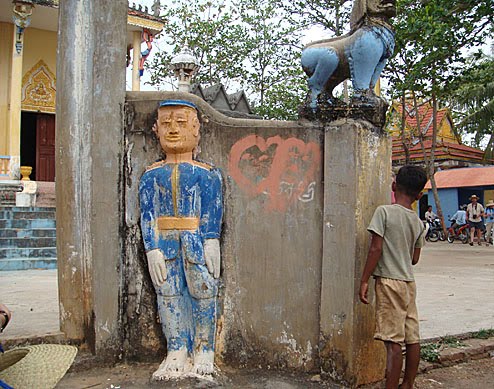
This military guardian figure in blue is on guard duty outside the pagoda on top of Phnom Han Chey
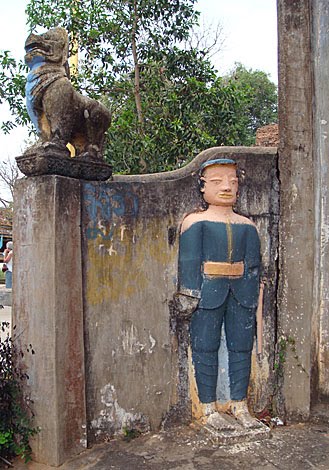
On my recent visit to Kompong Cham, I came across a selection of guardians and the like that can form an intriguing part of any trip into the Cambodian countryside and to any pagoda, in trying to decipher what they mean or represent. On this occasion, I didn't have a knowledgeable Khmer companion with me so some of those shown here remain a mystery. Unless you know better.
Accompanied by his nearby lion, this military figure stands on the other side of the doorway to the pagoda
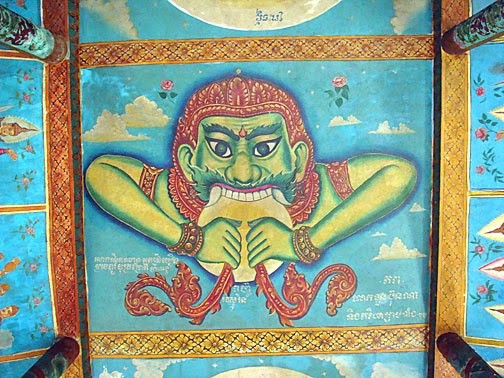
A popular figure on the ceilings inside many modern pagodas is Reahoo (or Rahu), usually found munching on the moon to cause an eclipse - not one of the nice guys.
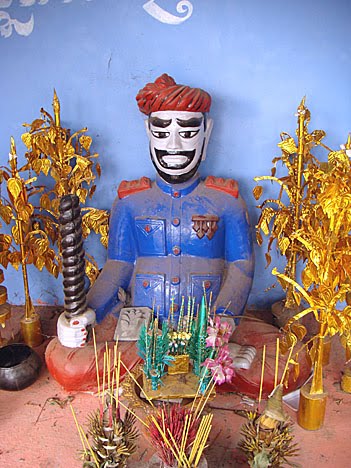
And no self-respecting pagoda should be without its own Neak Ta Dambong Dek figure to ward off evil spirits
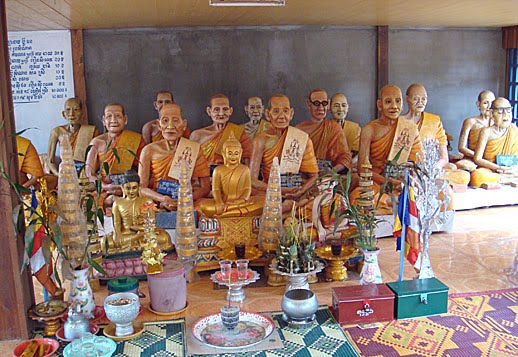
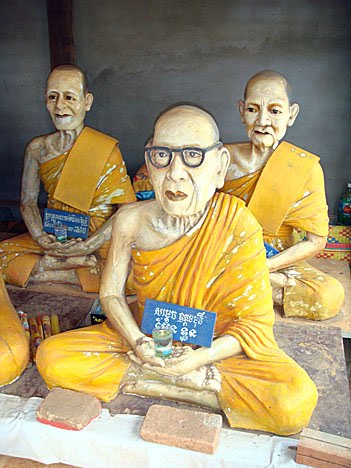
Wat Han Chey is also home to a room dedicated to 16 of Cambodia's most respected and revered monks
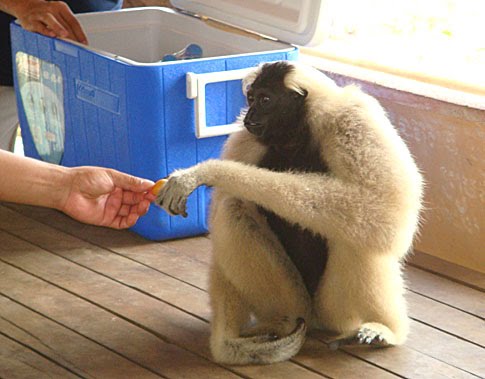
Another guardian at Wat Han Chey is this pretty tame female Pleated Gibbon character
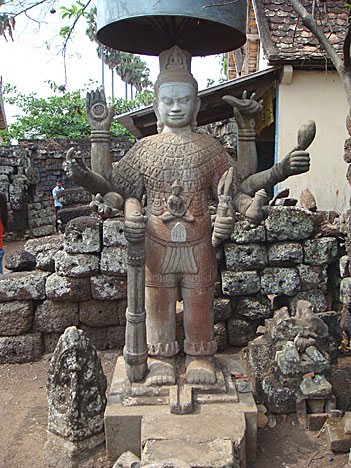
At Wat Nokor, just inside the entrance to the main chamber, there are two standing Preah Noreay statues. They are part concrete and part original in my opinion, though I overheard 1 guide saying they were cement copies.This figure has 8 arms.
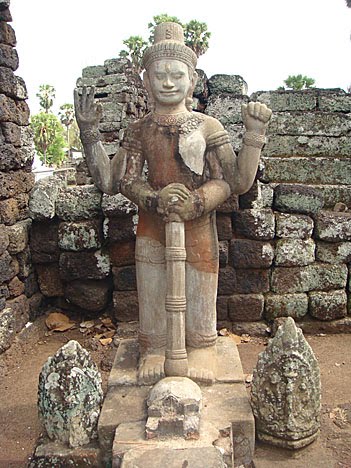
Here is the 2nd large Preah Noreay figure, with 4 arms, at Wat Nokor. Most of this figure is reproduction.
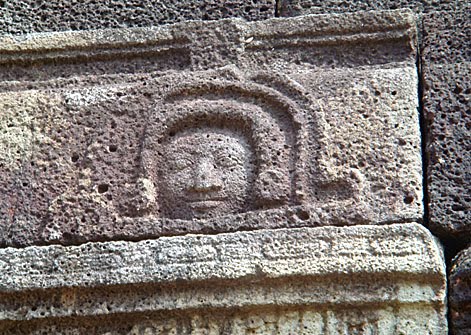
Finally, this small face, one of 40, peers out from the basalt wall of Kuk Preah Theat at Phnom Han Chey
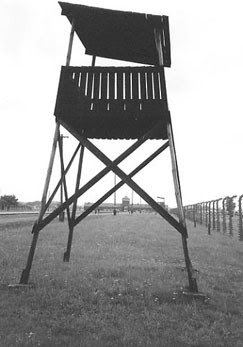
Haunting and evocative film soundtracks are a speciality of Ennio Morricone. Listening to the song by BosbaPANH this morning reminded me of the maestro's composition for the film Fateless (Sorstalansag), which was released in 2005. Set in the concentration camp of Auschwitz-Birkenau, a place I visited myself a couple of years earlier, this is Morricone doing what he does best, taking control of your emotions and grabbing you firmly by the heart-strings without letting go. There is no one better. Read more about Fateless here.
A watch tower at the concentration camp of Birkenau
This song, Neak Me (Our Mothers) by BosbaPANH is so haunting. She dedicated it o her grandmother. Here is what the young soprano had to say in her blog yesterday about the 35th anniversary of the fall of Phnom Penh: 17th April 1975. Today is the 35th anniversary of the sad date when my grandmother, grandfather, aunts, uncles, cousins, so many members of our family disappeared. I have never met my grandmother and only hear from my dad who she was. A strong and fierce lady who run the house and the family, of honor and dignity. She was a fine cook, he told me. And that's true, when we visited her native village, the population still remembers her skills. She was cooking French dishes, Khmer desserts and samlor as nobody else could. When the French delegation came in the village, she was called to manage the kitchen and cook for the dignitaries. She seems perfect to me. Strong in her heart, in her behavior. She was the last to die, witnessing her children, grandchildren, husband disappear. It always make me sad, we have only one photo left of her and grandpa. My younger brother is named after him, Panhlauv. Dad wrote the lyrics of the song "Neak Me" and it makes me want to cry each time I sing it. Neak Me is the name of BosbaPANH's latest DVD release of a recent concert held at Chaktomuk Theatre as well as a behind-the-scenes look at rehearsals and the concert, which took place in September of last year. Find out more here.
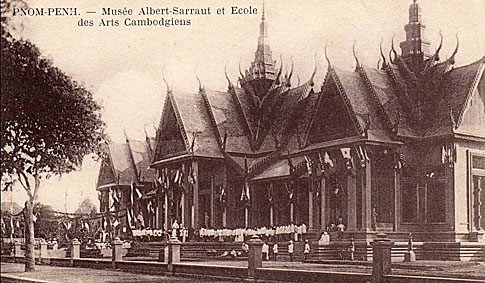
An old postcard showing the opening ceremony in 1920
April 1920 saw the opening of the National Museum of Cambodia. Kent Davis at his devata.org website has the inside story and pictures from Nicole Groslier, daughter of the museum's designer and first conservator, celebrating the museum's 90th anniversary.
A far less welcome anniversary, is the arrival in Phnom Penh 35 years ago today, of the Khmer Rouge to begin a period of Cambodian history that has affected every member of the population. Within days the city's inhabitants had been forced out into the countryside and Phnom Penh became a virtual ghost town. The rest is history of the worst possible kind.
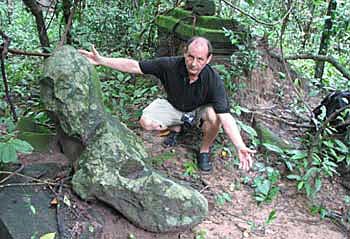
Peter Sharrock locates the legs of the 3-metre high Hevajra at Angkor Thom
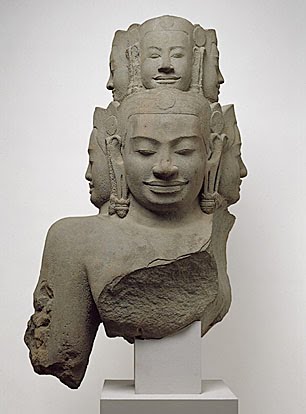
Peter Sharrock is a former Vietnam War correspondent turned archaeology professor, and is now a senior teaching fellow in the art and archeology of Southeast Asia at the University of London's School of Oriental and African Studies. He covered Indochina for four years as a reporter and finally made it to Angkor in 1990. His doctorate is on a new interpretation of the Buddhism and imperial politics of King Jayavarman 7th. He is now focusing on the evidence in Indochina for the influence of tantric or esoteric Buddhism, developed in the Ganges valley and developed in different ways throughout Asia. His interest in Hevajra, a warlike tantric deity, prompted him to go looking for the missing parts of the 3-metre high sandstone statue that he'd seen in yellowing photographs from EFEO. The bust is now with the Metropolitan Museum of Art in New York but the rest of the body - all 16 arms, one of its heads and its legs - lie elsewhere. The discovery of the legs of Hevajra, hidden in the forest surrounding Angkor Thom, has re-opened the mystery and a new chapter in understanding more about the reign of the great Khmer king, Jayavarman 7th.
The 7-headed bust of Hevajra at the Metropolitan Museum in New York. It was sold to the museum by EFEO.
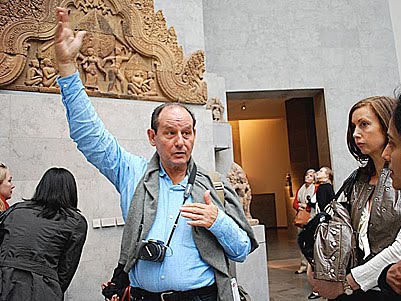
Peter Sharrock shares his knowledge of Southeast Asian art at the Guimet Museum in Paris. Photo courtesy of Radhika Dwivedi.
Whilst I'm on the subject of King Jayavarman 7th, Peter Sharrock and the cult of Hevajra, I hope you caught sight of reports in the media last September that highlighted Peter Sharrock's amazing find in a forested area just outside the walls of Angkor Thom, of the massive legs belonging to a 3-metre statue that depicted Hevajra, a warlike tantric Buddhist deity that was crucial to the religious beliefs at the time of Jayavarman 7th. If you didn't, then here is a Q&A that Peter Sharrock sent me, just to put you in the picture.
1. Tell us why this find is so significant? How important is this to the world of archaeology?
Scholars are currently radically revising our understanding of the Buddhism of the ancient Khmers. The single most important icon informing this radical change of view is a large, broken sandstone image of the fierce, supreme tantric Buddhist deity Hevajra, whose bust stands in the New YorkMetropolitanMuseum. After almost a century of being side-lined, this icon is now being repositioned as the crown jewels of Khmer tantric Buddhism. We can now hope to experience the full power of this statue because a large missing piece has just been found.
On a field trip to Angkor this summer I decided to try to find the spot where parts of the icon were first excavated in 1925. To my amazement I succeeded in locating the massive legs deep in the forest outside the ancient capital of Angkor Thom.
The French, who pioneered the restoration of the vast medieval temple complex around Angkor Wat, thought the Khmers had venerated only the compassionate Bodhisattva Avalokitesvara, like many other peoples across the northern Buddhist world of Mahayana. They acknowledged that bronzes of Hevajra had been found but thought they must be minor. Eminent art historian Jean Boisselier for example wrote in 1951: ‘The [tantric] bronzes from the 12th and 13th centuries constitute a fairly considerable group but with no stone statue being reported for the same period, the importance of the role these divinities could have played in Khmer Mahayanist beliefs is strongly diminished.’
But a consensus is now forming for seeing the royal cult of Angkor in 1200 CE as centred on Hevajra, known mostly from Tibet and the Tibetan-influenced Mongol dynasty of China. Realigning Angkor with Tibet and Yuan China is something of a tectonic shift in archaeology.
Cambodia's greatest king was Jayavarman VII who brought the Khmer empire to its apogee from 1182-c.1218. He broke with a 400-year tradition of venerating Shiva as the deity of state and turned the Khmers to Buddhism forever. By the 14th century Cambodia moved to the southern, Theravadin vehicle, which still dominates the country today. It comes as something of a shock to modern Khmers to learn that the king known for bringing them Buddhism venerated the tantric Hevajra.
My earlier research had pinpointed two pieces of evidence that are crucial to the shift in evaluation: (1) the world's museums contain a large group of bronze Khmer consecration conches or conch stands which bear an image of the eight-headed, 16-armed god who dances on the corpses of Hindu deities. This indicates that the Hevajra-Tantra (translated by Professor David Snellgrove of SOAS) cycle of four consecrations, one possibly involving yogic sex, must have been key rituals in the Bayon state temple, famous for its mysterious giant face-towers, and in the other great temples Jayavarman built. (2) A second clue comes from a contemporary Chinese account (dated 1225) that says 300 women or 'blisses' skilled in such rituals were performing in the king's temples.
Recovering the legs of the statue and launching an archaeological excavation to possibly recover the other missing parts will hopefully enable us to reconstitute this Hevajra in his original three metre high form. I had earlier attempted a virtual reconstruction of the icon using the French archive photographs. The public re-emergence of this icon should attract resources to boost the radical revision of Khmer Buddhism that is underway. The scientific excavation in the forest may now also uncover clues as to the circumstances, reasons and timing of the way in which it was apparently broken and 'dumped' some 250 metres outside the fortified walls of the capital, Angkor Thom.
(My own hypothesis about the dumping is that these icons were probably caught up in a brief Brahmanical reaction against Jayavarman’s temples a century after he died when many Buddhist icons were destroyed and the Bayon converted to Hindu ritual. The Hevajra so important to Jayavarman’s cult was presumably removed from its sanctuary in the Bayon and paraded out of the city to have its power broken by being ritually smashed beyond the city walls).
Ancient Angkor rivalled any city in the world in size and organisation during the reign of king Jayavarman VII. The construction of roads, hospitals, canals and temples was on an unprecedented scale. The population of the city probably exceeded 500,000. Since the French cleared the forest from Angkor's vast complex of elaborately decorated stone temples, it has become one of the largest and most beautiful tourist attractions in Asia.
2. Why do you think nobody discovered the legs before?
The broken statue was first discovered by French archeologists in 1925. They took away the beautifully carved bust along with several other Buddhist sculptures apparently dumped together in an earthen mound, but they could not identify the 'giant' they found broken in two. The giant bust with multiple heads was taken to the conservation depot but the legs were apparently left at the site where I found them 84 years later.
Ten years after being excavated the 52-inch bust was sold as an Avalokitesvara by the FrenchSchool for the Far East (EFEO) to New York's MetropolitanMuseum. Curator Alan Priest ascertained that it originally had eight heads and 16 arms and therefore correctly labelled it Hevajra. Apart from a brief catalogue mention, nothing was written about the giant Hevajra in New York until Professor Hiram Woodward asked some ground-breaking questions about it in an article on ‘Tantric Buddhism in Angkor Thom’ in 1981. The next shift in the debate came in my own PhD at SOAS, which built on Woodward’s work and made the case for seeing Jayavarman’s Buddhism as in essence tantric and focused on Hevajra.
I’m sure that local villagers who live among the Angkor ruins have come across the legs of Hevajra in the forest, but the broken part would only have meaning to someone who had seen the French archive photographs. Certainly no-one ever reported it to the Apsara authority which is responsible for conserving the heritage of Angkor.
3. What did the authorities say to you? What was the reaction like at the conference?
I announced my find a few days later at a large conference at Sisophon, near the modern Thai border, concerned with the current restoration of Jayavarman’s vast Banteay Chmar temple, the last great Khmer provincial temple to be excavated, restored and protected. In attendance were the province governor, top officials of Apsara and the Ministry of Culture and Fine Arts, Phnom Penh museum director Hab Touch, temple restorer John Sanday of the Global Heritage Fund, Dr Helen Jessup and Joyce Clark from the Friends of Khmer Culture International (FOKCI), whose support and organisation made the conference possible, and a large gathering of Khmer and international art historians and archaeologists – including Hiram Woodward. I spoke about the importance of the New York bust and then showed photographs of Hevajra’s legs still lying in the forest. This was greeted with delight and astonishment. After my paper the Ministry of Culture asked for a copy of my presentation and I was invited to be driven back to Angkor at the end of the conference to show Dr Hang Peou of Apsara the find spot. The following morning Dr Peou personally supervised the removal of the legs to the Sihanouk museum in Siem Reap.
4. So what next? Will the legs be reunited with the rest of the statue? Will you be helping to arrange this? Any other details you would like to add?
I am in touch with all parties involved, who are already in communication, to try to find a way of reuniting the pieces so that Jayavarman’s icon can be viewed in its original state. Meanwhile Apsara plans an excavation of the site in search of the missing eighth head, 16 arms and feet. It may prove to be a difficult negotiation, because New York and Phnom Penh museums would no doubt both like to exhibit the whole. Can some shared solution be found? I am in contact with curator John Guy (ex-Victoria and AlbertMuseum) in New York and Hab Touch in Phnom Penh. Professor Claude Jacques, the eminent Paris-based Angkorian scholar, has offered to join the group of experts to be consulted.
5. Did you feel like a modern-day Indiana Jones?
I don't know how he could wear that hat in a tropical climate. But there is a distinct feeling of the unreal or fictional about going into the jungle and actually finding something of such importance to my research and to Cambodia’s history. It took a few days for the feeling to wear off that I had dreamed it all. Indiana and I do I suppose share the experience of feeling close to ancient civilisations that are very obscure to most people.
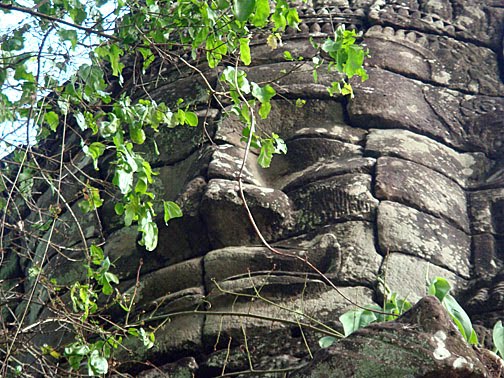
A face tower at Banteay Chhmar that could represent the tantric deity of Vajrasattva
Banteay Chhmar is a fascinating temple complex in northwest Cambodia. It's a temple built during the rule of King Jayavarman VII in the 13th century and unlike the temples constructed at Angkor around the same time, it didn't suffer the iconoclasm that engulfed temples such as the Bayon and Ta Prohm, where Mahayana Buddhism images were chiselled away and defaced after the King's reign came to an end. To that end, Banteay Chhmar can reveal a lot more about the time and beliefs of Jayavarman VII than other sites. That's if it was still in pristine condition. It's not. It too has suffered the ravages of time and temple thieves and only 25% of its bas-reliefs are still standing. The rest lie in pieces on the floor or have been stolen and lost forever.
The Global Heritage Fund and its many partners are now trying to piece the temple back together again. Stone by stone, carving by carving. Last year they held their 2nd conference about the temple in Sisophon and you can find out much more about the project to renovate and restore Banteay Chhmar from the video-papers presented by various speakers here. One of the speakers was Dr Peter Sharrock, a scholar from the University of London, who had his own view on the identity of the giant face that stares out from the face towers of Banteay Chhmar, the Bayon and elsewhere. He discounts the possibility that it is the face of Jayavarman VII himself or the Avalokiteshvara, which is often stated in guidebooks and the like and instead suggests the face belongs to the tantric deity of Vajrasattva. "I think its the supreme deity presiding over a tantric cult of Hevajra. I said Vajrasattva in my chapter in Joyce Clark's book Bayon, New Perspectives in 2007 and nobody has yet argued against this analysis. Let's wait and see. Hevajra is a fierce emanation of Vajrasattva, who is more of a primordial conception than a god you could picture or address," he told me by email today. If that's the case, and proving it will solve one of the key mysteries that still envelope Angkor, then every book on Angkor will need to be updated.
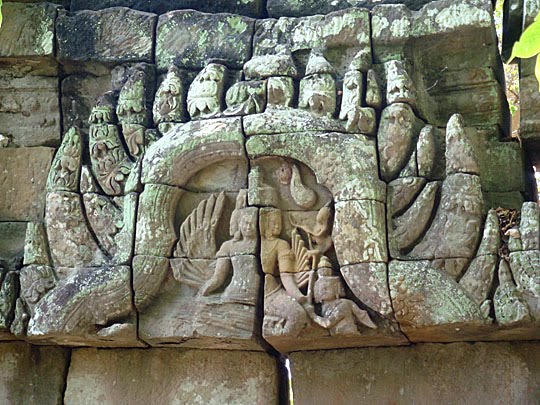
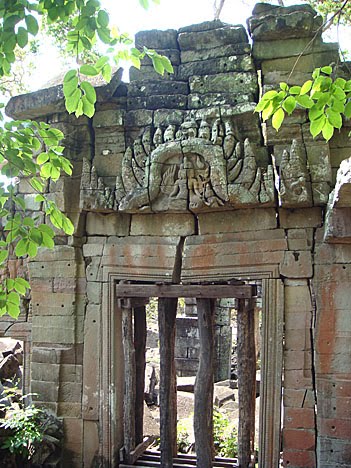
Sharrock also highlights a carving at Banteay Chhmar that he believes is the first representation of Hevajra in stone, rather than the more common statues of the deity in bronze. This is of massive importance to understanding more of the Buddhism promoted by Jayavarman VII and is one way in which Banteay Chhmar can tell scholars so much more about that period of Cambodian history, which fascinates so many. The secrets of Banteay Chhmar are still waiting to be discovered. I've written an essay on the temple for my book To Cambodia With Love, which should be out in June, as it's one of the ancient temples that I have a close affinity with, after my first visit there in November 2001.
Scholar Peter Sharrock believes this carving at Banteay Chhmar is of the deity Hevajra, with 20 arms and 9 heads. A smaller figure below has 5 heads.
The carving is above a doorway that is unstable and will be one of the tasks of Global Heritage Fund to ensure that this wall is safely preserved
Looking out across the Tonle Sap River in Phnom Penh at sunrise
Helen Ibbitson Jessup is a renowned scholar and author on the art and architecture of Southeast Asia and as President of the Friends of Khmer Culture, is a regular visitor to Phnom Penh. One of the essays she submitted for my To Cambodia With Love book talks about one of the many pleasures to be found in the city. It didn't make the final draft. Find out more about the author here.
Early morning in Phnom Penh - by Helen Ibbitson Jessup
Before the dawn light strengthens, a stroll along the riverbank in Phnom Penh is a time warp.The water is pewter, and ripples from the wake of fishing boats flash silver.Silhouetted against the paling sky you can see curving prows suggesting the profiles of the ships carved in the reliefs of the Bayon temple. Naga figureheads rise commandingly, invoking the serpent who rules the waters and the underworld, recalling the ancient Khmers’ fleets repelling the invading Chams on the waters of the Tonle Sap in the days of Jayavarman VII.No intruding engines sputter as nets are cast, these modern fishermen for a while embodying the reincarnation of their ancestors.
Sunrise, like sunset, is a hurried affair in the tropics, and the warming light quickly dispels the illusion.Soon the vendors gather along the road by the bank.Some hack open a coconut to tempt the buyer, some offer juicy pink pomelo segments.There are fresh baguettes, a relic of the French presence.The flags of many nations flap in the strengthening breeze on the brave show of poles lined up along the river near the RoyalPalace, motos roar in a thickening stream, and shopkeepers remove the night shutters.You are back in modern Cambodia, in a real city, going about its business without a thought of the tourist.
The riverside park in front of the National Museum and Royal Palace, the park at Wat Botum and the National Olympic Stadium have become magnets for Phnom Penh citizens who want to exercise at the start of the day, and as dusk falls over the city. The exercise bug has firmly struck the citizens of Phnom Penh.
Photographer Steve Goodman loves taking pictures around the busy alleyways of Phnom Penh. And he does it bloody well I must say. Steve gave me a few essays for my own To Cambodia With Love book that's due out in a few months and this one on his alleyway pursuits is one that didn't actually make the final cut. However, it's worth posting here. You can see more of Steve's photographic work here. Phnom Penh's Alleyways - by Steve Goodman
As a photographer I enjoy going where other travelers do not tread, not only to witness and photograph everyday life, but also to meet and interact with everyday people and enjoy the surprised and delighted reactions of Phnom Penh’s denizens when they see a foreigner not only intruding into their private lives but demonstrating interest and warmth. I have never failed to be amazed at the almost uniformly friendly and warm greetings that I receive in long winding alleys and hidden side-streets that aren’t depicted on most maps.
Of course Phnom Penh’s bustling markets are fantastic places to wander around, but they are generally crowded and can be sweltering, especially during the hot season. So aside from shooting photos in the beautiful light of the early morning and the golden light of sunset, I enjoy wandering through Phnom Penh’s alleyways, where even on the hottest of days it is shady and relatively cool. One time on an alley behind the busy Kampuchea Krom boulevard, an entire family invited me into their shophouse where they sold traditional Khmer herbal medicine, and treated me to a few candied fruit treats laced with traditional herbal remedies.
Often people who are eating on their stoops offer me some of their food. Me, a total stranger whose only calling card is a smile and a few words of greeting in Khmer. Sometimes I meet folks who speak a bit of English, but just as often I meet people who seem to speak fluent French and are sorely disappointed when I let them know that I don’t speak the language even a little bit. Of course the children that I meet are the most amazing people I encounter… playing, laughing, and sometimes showing off their blossoming English language skills by saying, “hello, what is your name”. Sometimes the younger ones will proudly count to ten in English in an always successful attempt to impress and surprise the foreigner.
Most people are happy to permit a few photos if asked with a smile. Often times when someone is initially reluctant, after I show them the photo they enthusiastically invite their friends and relatives to come and have me take their pictures too. The only time I get a negative reaction to a photo request is when I ask people who are gambling huddled around a card game, so I’ve learned simply not to ask most groups of street-side card players.
Along many alleys are small cafes and pushcart vendors offering a wide range of snacks and beverages and the people milling about trying to beat the heat always have time for a brief interchange with a smiling camera wielding stranger.You'll also find businesses of all sorts in these mostly residential sidestreets; noodle factories, tailors, herbal medicine shops, and much more.
Everyone enjoys a freebie music concert and the news that the hip band of the moment, Dengue Fever will be performing an open-air gig on Thursday 13 May will come as music to the ears of many. The band will be in Asia as part of a world tour and the US Embassy in Phnom Penh have booked their services to celebrate the 60th Anniversary of diplomatic relations between the United States and Cambodia. The gig will take place in front of Wat Botum. The band will be in town for a few days and are scheduled to perform another gig, for the benefit of Cambodian Living Arts on 11 May, whilst a screening of the film about the band, Sleepwalking Through The Mekong, will be shown at the new Meta House on the 10th. Dengue Fever, with lead vocals from Cambodian-born Chhom Nimol, will bring their own brand of 60s and 70s psychedelic Khmer pop-rock back home, having previously played in Phnom Penh in 2005. The band originate from Los Angeles and have become a major tour de force on the American music scene, releasing three critically-acclaimed albums to-date. Visit the band at MySpace.
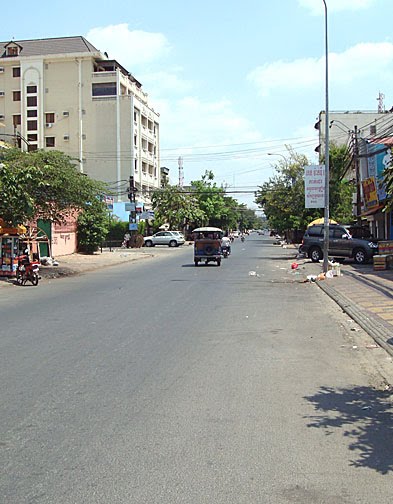
A disabled beggar was the only person on Golden Street at lunchtime today. I can see just 1 solitary tuk-tuk, when usually there are 15+.
Okay so the streets aren't completely empty over Khmer New Year, there are still a handful of people left in Phnom Penh but the two streets shown here are normally choked with people and vehicles at most times of the day. Golden Street or 278 to give it its real number, and Street 63 are popular and busy thoroughfares in Boeung Keng Kang 1 district. They also happen to be fairly close to my home. A few 'barang' restaurants are open in BKK1 too, which were doing a roaring trade today.
Street 63 at midday is usually a hive of activity and full of traffic. A solitary tuk-tuk and a couple of motos are kings of the road today.
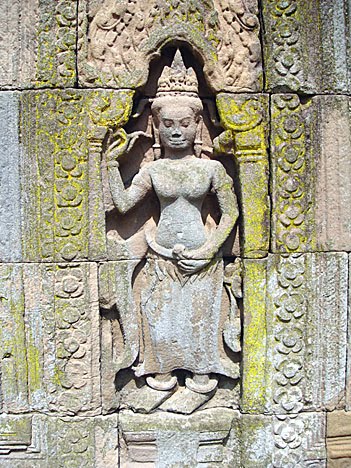
A devata from the wall of the outer enclosure at Wat Nokor. Yellow lichen is staining the sandstone walls.
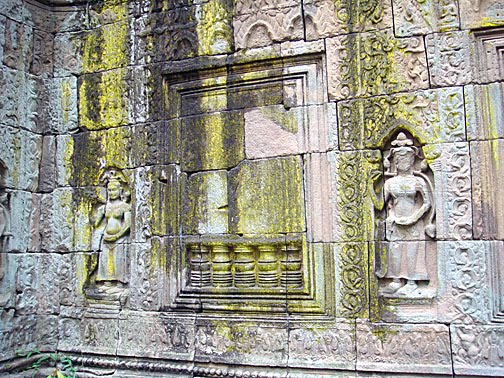
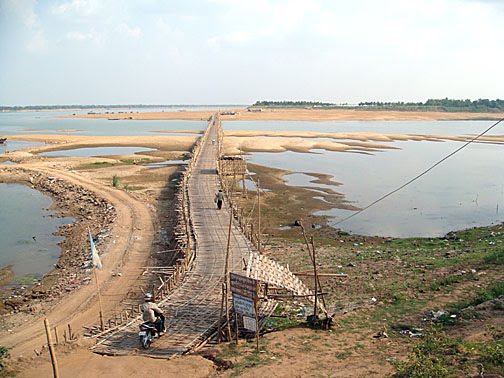
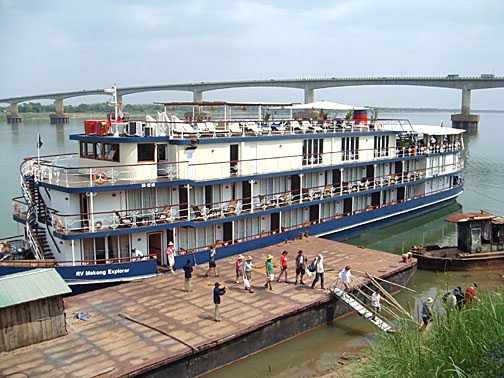
Here are a few more photos from my recent boat trip to Kompong Cham on the cruiser The Jayavarman. We paid a visit to the fusion temple of Wat Nokor, with its 13th century prasat incorporated into the modern pagoda at the same site on the outskirts of the city. I never have enough time in Kompong Cham. As an example I have still not been inside the small museum at the arts and culture offices, usually because its closed whenever I'm in town. Grrr. After the visit to Wat Nokor we headed back to the boat via an orphanage and a drinks stop at the bamboo bridge that acts as a passageway to the island of Koh Paen when the water level allows it. It costs a few riel to cross it depending on whether you are on a moto, cycle or car. There's always what seems to be a small sand-dredging operation taking place next to the bridge, as truck after truck gets loaded with sand swiped from the shallow waters of the Mekong River. We returned to the boat and enjoyed a lovely dinner aboard as we chugged our way seamlessly back to Phnom Penh, staying midstream overnight before disembarking at the boat jetty in the city after breakfast, amidst a thunderstorm I might add.
A false window with two devata either side of it at Wat Nokor
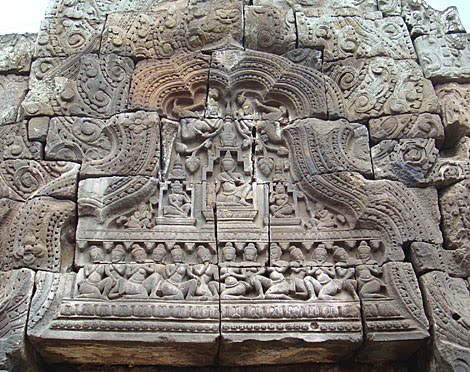
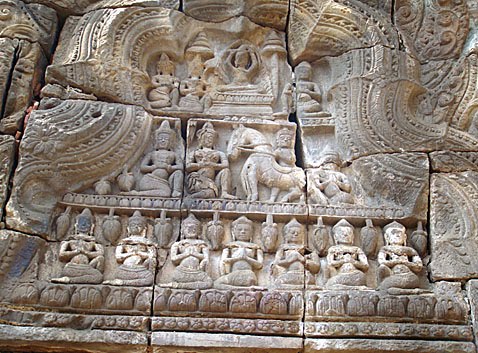
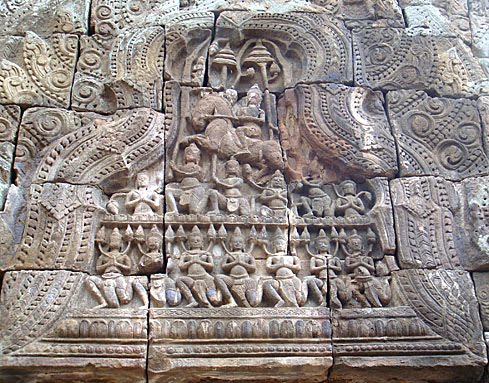
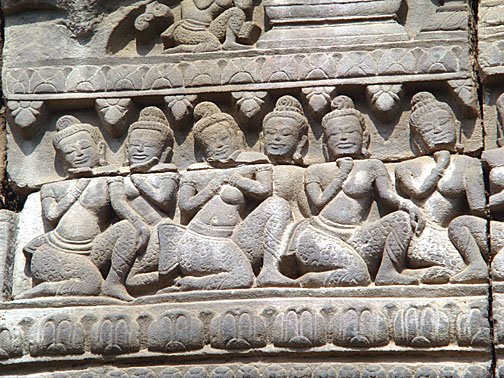
The lower register of the pediment on the western side of the central tower shows 13 women asleep. Above are more women in a pavilion also asleep and two apsaras flying above them.
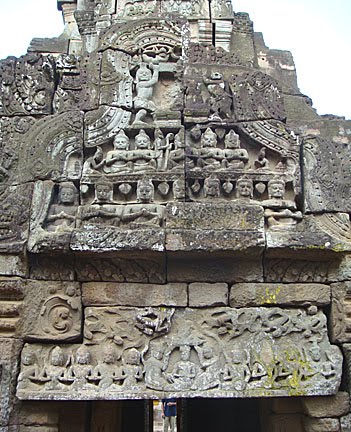
There are 3 registers on this 16th century pediment. Top shows the Buddha cutting his hair, the middle, he's freeing his horse and the bottom has 7 kneeling worshippers. Its on the southern side of the central tower.
On the western gopura, over its west doorway is two scenes on the pediment and lintel of Bodhisattva being tortured, though in poor condition
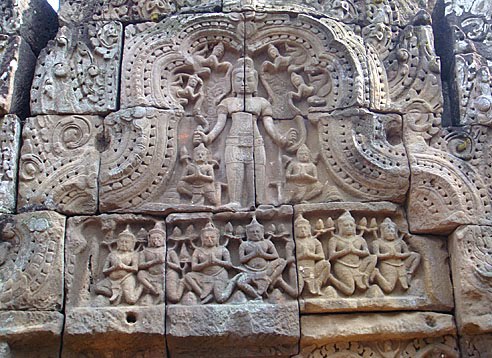
The north pediment of the northern gopura has a 2-arm Lokeshava standing between two kneeling figures and a lower register of 7 worshippers holding two lotuses each
The start of the bamboo bridge that connect Koh Paen to the mainland. You can see how low the Mekong River is by the exposed sandbars.
The Jayavarman cruiser docked at Kompong Cham, in the shadow of the Kizuna Bridge. Passengers can be seen disembarking.
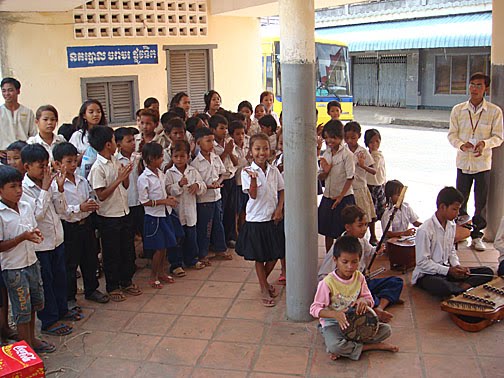
Children from a local orphanage give us a rousing welcome
I have lots of catching up to do and I'll start with some photos from my recent trip up the Mekong River to Kompong Cham on the luxury cruise boat, The Jayavarman. After visiting Wat Han Chey, we moored off the riverside road at Kompong Cham city itself and were met by a group of schoolchildren from a local orphanage who danced, sang and played music to offer us a welcome to their city. Then it was onto the bus to head for Wat Nokor, the temple on the outskirts of the city where the extensive 13th century prasat is fused with a modern Buddhist pagoda, though much of the remodelling of the ancient prasat was made in the 16th century. Essentially a temple that has undergone many changes and many faces. Today its an intriguing mixture of the old and the new. I've been there many times before but always see something new on each visit. One of the things that has always frustrated me is the central tower and its main doorway, which acts as the central shrine of the pagoda. The light is always so bad and the stone itself is very dark which means that I never get a good photo of the lintel and pediment above that particular doorway. After spending about an hour at the temple, we headed to another orphanage to look at the children's artwork and find out more about the orphanage before heading back to the cruise boat via the bamboo bridge that crosses an artery of the Mekong River to the island of Koh Paen, and is one of the tourist attractions the city has to offer. Even though its only in place for about six months of the year.
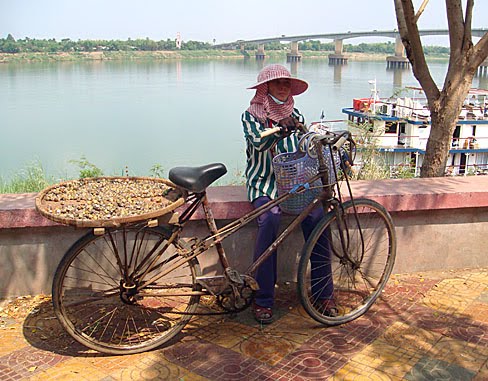
A local shell seller watches the children perform their welcome dance
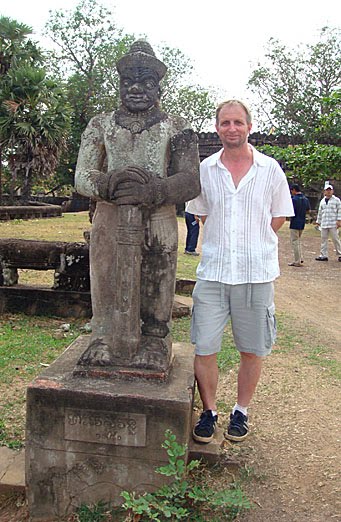
2 guardians at the entrance to Wat Nokor. I'm the one in the white shirt in case you are confused.
A pediment in marvellous condition on the northern face of the central tower at Wat Nokor. It shows the Great Departure with Buddha riding his horse and below are a row of worshippers each holding two lotuses. This pediment dates from the 13th century.
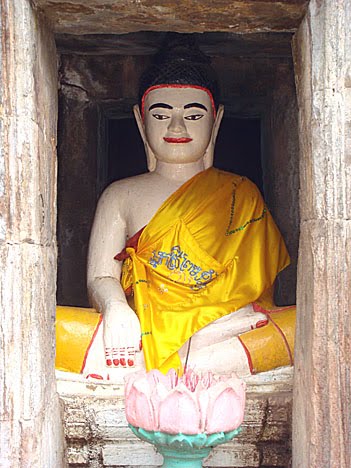
One of the modern colourful Buddha statues inside the central tower at Wat Nokor
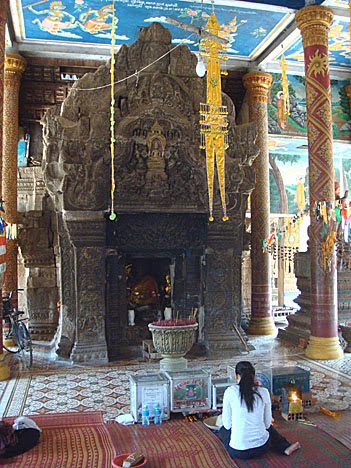
This is the eastern doorway of the central tower and shrine combined. Gold leaf highlights the pediment which shows Buddha's enlightenment and is believed to date from the 16th century.
This is detail from the lower register of the western pediment of the central tower showing a row of women, half-kneeling, each holding their head in one arm, with eyes closed, sleeping
The streets are already pretty empty, traffic is light, the motodops and tuk-tuk drivers have already packed up and gone back to their provinces for the Khmer New Year, which officially kicks off tomorrow for 3 days. If I didn't have a day job I'd have taken a great photo showing an overloaded pick-up truck full to brimming with humanity on its way to the provinces, but I'm stuck in the office, so I can't. I'm still coughing my guts up. Actually its a dry cough and its pretty painful. The cough medicine I got courtesy of the doctor works for about five minutes and then the coughing starts again. Everyone keeps telling me about their plans for the holiday - they're off to Siem Reap, the coast, Mondulkiri and so on - I think they're doing it on purpose because they know I'm staying at home. People can be so cruel. Even the local football which keeps me busy at weekends has been postponed for a week, so it's lucky I have a large pile of unread books to get stuck into over the next few days. I've already got my provisions in as most shops and restaurants will close too. I'll be humming The Specials' Ghost Town over the next few days.
Peter Sareth Pen has spent the last thirty years in America after escaping the Khmer Rouge regime in Cambodia. Now he's coming home. He's also self-published a book about his life, Escape to America, which has just become available. Pen made it to a Thai refugee camp in 1978 where he joined his wife and members of his family before finding his way to the United States a couple of years later. He recently ended his job as a social worker in Modesto and will return to Cambodia with his wife and eldest son in search of work. He'd like to work at the American Embassy but if not, a teaching job sounds possible. Another memoir to hit the bookshelves in the last month is the story of Chhalith Ou and his flight to safety out of Cambodia as a twelve year old, before getting passage to the USA in 1979. Now living in Chicago, he tells his story to R Z Halleson in Spare Them? No Profit. Remove Them? No Loss- the true story of a young teenager in Pol Pot's Cambodia, and published by iUniverse. This is a harrowing tale of a child's life under the brutal Khmer Rouge regime, joining others in the genre.
Helen Ibbitson Jessup has her name in the frame for a coffee-table sized book, Temples of Cambodia: The Heart of Angkor, to be published by Vendome Press sometime this year, or maybe next. No-one is sure. Fine art photographer Barry Brukoff is signed up to do the photographs. With 240 pages with 225 colour illustrations, the book will be organized chronologically and the combination of Jessup and Brukoff is what some would call a dream-ticket. River Books are also set to publish a book on Cambodian temples with Jessup and Ang Choulean sharing the text duties, called Beyond Angkor and photos by John Gollings, concentrating on temples outside the Angkor complex. It's bated breath time again.
Update on my health - it ain't great. I watched football over the weekend at the Olympic Stadium but aside from that I have slept. My chest infection has given me a dry, painful cough and runny nose and my eye infection is getting worse. That's despite the bucketload of tablets I'm taking every day. Just managed to get into see the doctor at midday today so we'll see what her prognosis is. Everyone keeps asking me where I'm going for Khmer New Year. At this rate I'll be stuck in bed for the five-day break beginning Wednesday. I feel like crap to be honest.
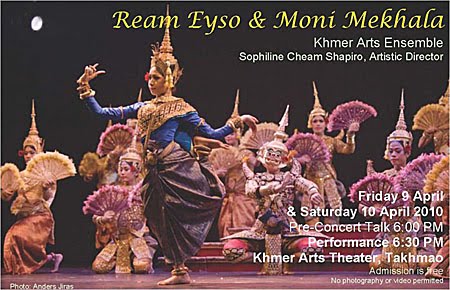
A chest infection has laid me low so I had to miss the two Khmer Arts Ensemble performances at their Takhmao headquarters last night and tonight. A real shame for sure. These classical dance shows are so irregular that it hurts to miss the opportunity. They were performing Ream Eyso & Moni Mekhala in celebration of next week's Khmer New Year. I'd found it almost impossible to get to see a doctor yesterday and had to make do with a visit to a pharmacy for a bagful of tablets, the Khmer way of dealing with any kind of health problem. The more tablets the better. My dry coughing is giving me a splitting headache, so even more tablets required for that. I did get out to football this afternoon and will try again tomorrow but aside from that, I'm stuck indoors, feeling sorry for myself, of course.
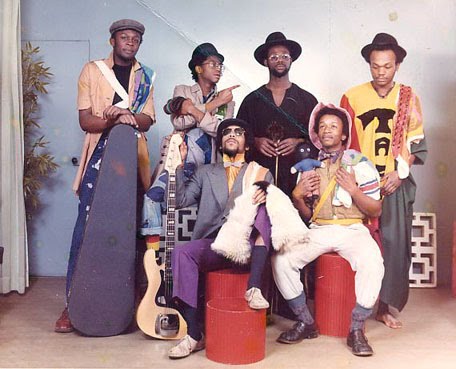
Steel Pulse in all their early 1975 glory. LtoR: Selwyn Brown, David Hinds, Michael Riley, Basil Gabbidon; [front row] Ronnie McQueen, Colin Gabbidon.
35 years ago Steel Pulse played their first ever gig. Two of the original band members, David Hinds and Selwyn Brown, continue their musical journey today as Steel Pulse perform all over the globe with recent appearances in Australia and New Zealand, Jamaica, the Virgin Islands and Florida. But it was all very different back in 1974 and 1975 when the fledgling band's rehearsals were moved to David's cellar at 16 Linwood Road in Handsworth, Birmingham, which was to be ther base for the next few years. Selwyn recalls, "we used to rehearse in Ronnie's attic bedroom for a while. Then David's dad let us use his basement at Linwood Road, as we got more serious about it and just started practicing and practicing. We basically taught each other to how to play, so there was no ego thing. We just wanted to play and enjoy music and inspire people and write something conscious." At the time, Basil Gabbidon and Selwyn were responsible for most of the lead vocals though Colin Gabbidon felt David could take on more of the mantle and did his best to persuade him to do so. Alongside covers of Bob Marley, Peter Tosh, Burning Spear, The Abyssinians and The Gladiators, there were early versions of their own compositions like Nyah Luv, Handsworth Revolution and a rock-soul track that Basil wrote called Conscious. Colin recalls," Basil was writing a lot of music as was David. A lot of things were written in 1974. I think we were finding our identity, that was when we were clicking. We'd been together for less than a year and were working so fast. The excitement was high, we were anxious, we were keen, we wanted to express ourselves. We were serious and our music reflected what we were." The name of the band posed a problem, which was solved by Ronnie McQueen, who had a passion for horse-racing. He liked the name of one horse in particular, the Scobie Breasley-trained 1972 Irish Derby winner called Steel Pulse and suggested to the rest of the band that they take the name as their own. Everyone agreed. It seemed to fit perfectly.
It was now the right moment to expose the band to public scrutiny. Lee Allen, their advisor-cum-manager at the time and former keyboardist with local band The Phantoms, booked them their first live gig locally at a small working-class public house called the Crompton Arms. A hub for local bands at the time, the pub was located on Crompton Road in Lozells and the audience for their debut performance, in January 1975, numbered the pub's regulars and friends of the band. Selwyn did the majority of the lead vocals as they played a mix of cover versions of Marvin Gaye, Bob Marley and Ken Boothe and some dub numbers. The six-strong band line-up for that debut gig was Selwyn Brown, David Hinds, Michael Riley, Ronnie McQueen, Basil and Colin Gabbidon. It went well, Lee Allen recalls, "all hell let loose, everyone was so excited," the band received the princely sum of £20 for their efforts and they used it as a spring board for a handful of gigs at other local venue's like Barbarellas on Cumberland Street and the Grand Hotel in the city centre, the Ridgeway on Soho Road, the Tower Ballroom in Edgbaston, at the former British heavyweight boxing champion Bunny Johnson's club in Digbeth befiore it burned down and they returned to their old school on one occasion to play a reunion gig. Steel Pulse had begun their musical journey to greatness, one which continues to this day. To find out more, click here.
Some of the Hanuman team watching the traditional Robam Trot performance
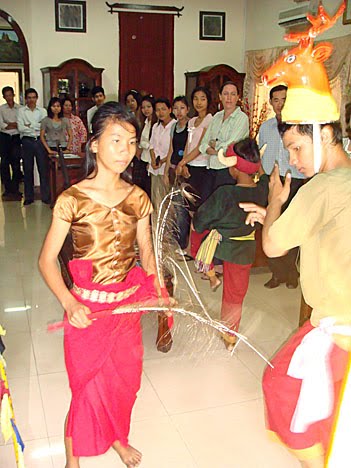
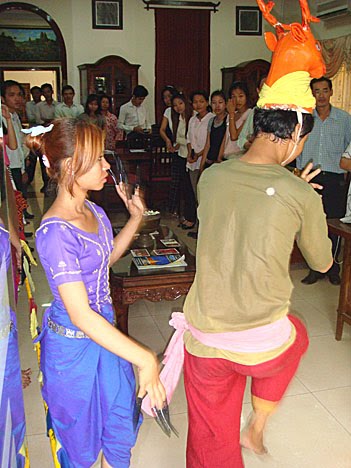
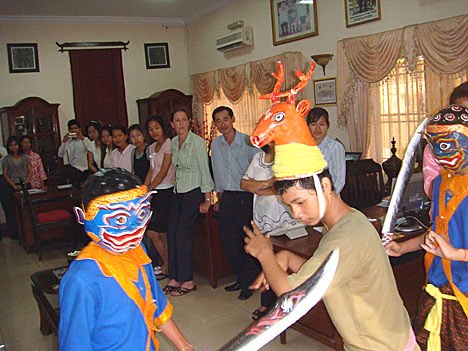
At the Hanuman office a few minutes ago we enjoyed one of the traditional New Year's ceremonies called Robam Trot, which originates from Stung Treng and involved youngsters from the Cambodian Light Children's Association orphanage. Dressed up in traditional costumes, they symbolized chasing away any bad spirits and bringing prosperity by re-creating the hunting of a deer. Perhaps not politically correct but its a tradition and something we do at Hanuman every year. Over the last few nights music and laughter has been ringing out til late at night in the streets surrounding my house with traditional games such as Angkunh, Leak Kanseng, Chhoung and Dandoeum Sloek Chhoeu being played by groups of boys and girls, who've also formed dance circles until midnight. For much of next week the city will be like a ghost-town with everyone disappearing to their home villages across the country.
The introduction of two beautiful girls with very long fingertails was welcome
It was a tight fit for the ceremony, held at the front door of the Hanuman offices
Like a typical bloke, I'm a bit under the weather and feeling sorry for myself. I even went to bed early last night which is unusual for me, but the heat is pretty unbearable in Phnom Penh at the moment and I've been afflicted with an eye infection, a cough and head cold, a horrible coldsore and aches and pains. Occasionally I might get one or the other, but never all at once. We're approaching Khmer New Year which will be upon us next week. Everyone asks me what I'll be doing and to be honest I've made no plans at all, unlike in previous years. I have five days away from the office, probably stuck at home catching up with all the blog posts I should've been posting in the last few months. I've got such a backlog, as well as a pile of books to read that I could conceivably spend five days not speaking to another soul, particularly as Phnom Penh will be like a ghost-town anyway, with all the residents heading out to their home villages. To brighten up my day, here's a picture of one of my friends, the ever-smiling Alin, a native of Kompong Thom province who has lived in the city for about five years now and like most, will be heading for the village of Baray for much of next week to visit her parents.
Alin never stops smiling - she's like a breath of fresh air
Fellow passenger Mala and myself enjoy some Mekong viewing at Wat Han Chey
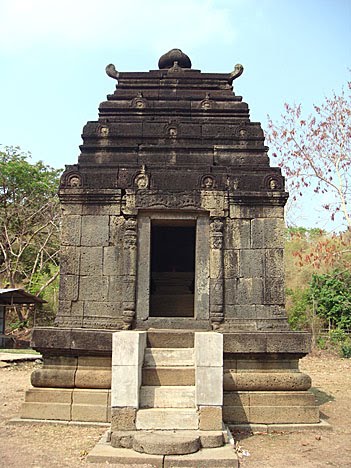
Every time I visit Wat Han Chey near Kompong Cham, thre is some sort of celebration taking place. At the weekend just passed, it was the 5-day Chheng Meng, a Chinese celebration to their ancestors and the hill was dotted with small family groupings, often with a monk present, close to one of the distinctive Chinese-style graves. Phnom Han Chey lies 20kms north of Kompong Cham city though we didn't get there by road. Instead we took the more luxurious route via the Mekong River aboard the Jayavarman cruise boat, which docked at the foot of the hill. The passengers were given the option to walk the 295 steps to the top or get a moto. I walked. As the group received their background information from a couple of guides, I wandered around the temple grounds having been here a handful of times before. There is quite a bit to see, with the brick prasat, the sandstone cella, a couple of other ruined brick shrines, all from around the 7th century, a human-like gibbon that'll eat from your hand, a variety of other religious buildings, one containing wax figures of some of the country's most famous monks, and so on. Oh, and there's some beautiful views of the Mekong River as well. I always feel that a trip to Wat Han Chey is well worth the effort if you are stopping overnight in Kompong Cham. And as you leave don't forget to visit the renovated basalt tower at the foot of the hill, known as Kuk Preah Theat, that was put back together again with a donation from the US government. We got back on board the Jayavarman with our next stop in Kompong Cham city itself to visit Wat Nokor, after enjoying a gorgeous lunch. I could get used to touring like this.
The early morning sun trying to break through the clouds above the Mekong River
A family group gather at a Chinese gravesite for Chheng Meng
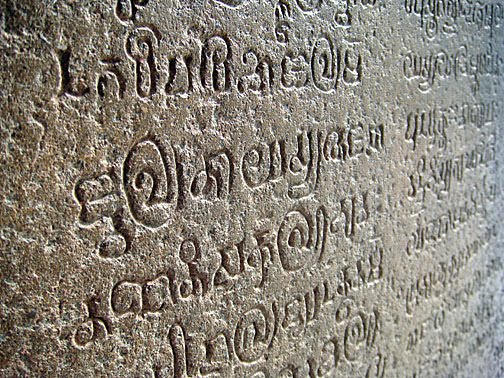
Part of the sanskrit engraved doorway at Prasat Han Chey
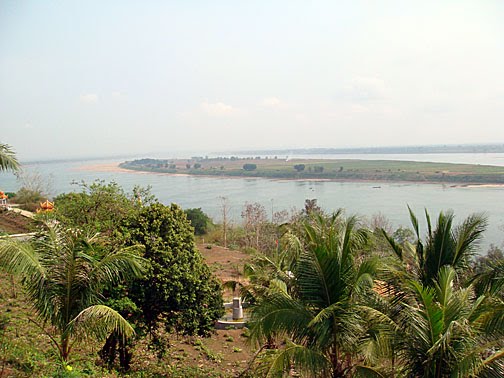
A look out over the Mekong River from Wat Han Chey
The reconstructed basalt tower of Kuk Preah Theat
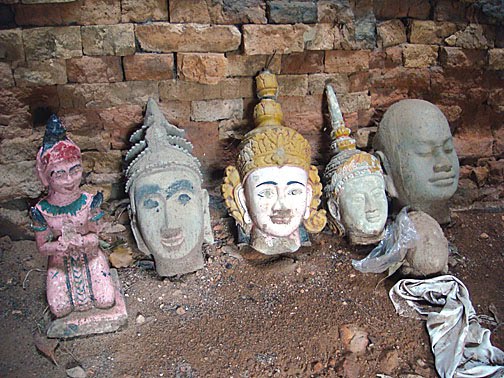
Buddhist heads on display inside the brick tower of Prasat Han Chey
Wax-work figures of three of the country's most famous monks
A wonderful opportunity to see classical Cambodian dance being performed by some of the most skilled practitioners of the artform in the country, is available this week at the Khmer Arts Theater in Takhmao, just outside Phnom Penh. For two evenings on Friday 9th and Saturday 10th April, the Khmer Arts Ensemble will perform one of the classic dances, Ream Eyso & Moni Mekhala, which is effectively a dance designed to bring on the rains as Mekhala, the water goddess with a crystal ball, battles with Ream Eyso, the storm spirit and his axe. The legend suggests this battle is the origin of thunder and lightning. The performances, which are free, will begin at 6.30pm after a half-hour introduction from the choreographer, Sophiline Cheam Shapiro.
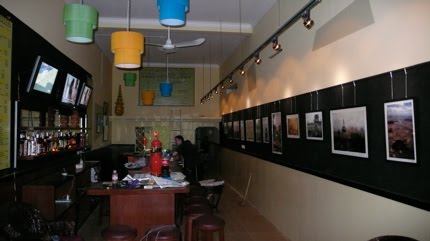
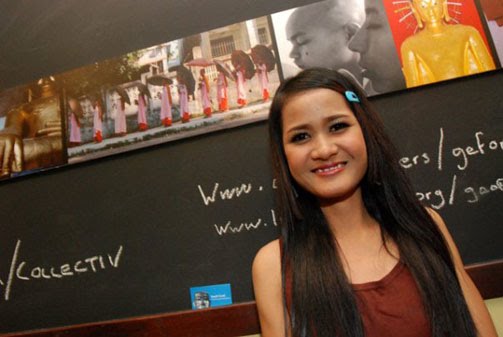
The monthly art exhibitions at the 4Faces Gallery in Siem Reap have sadly come to an end, with photographer, part-owner and pal of mine, Eric de Vries relinquishing his interest in the gallery-cum-bar. Eric will continue to live and work in Siem Reap and is looking to relocate his gallery elsewhere in the future. In the meantime he has his SEA/collectiv work to push on with as well as his own projects.
The end of pretty pictures in and on the walls of 4Faces
Belle, during a solo in the show, gives the piece a certain gravitas
The final performance of Movin' at Sovanna Phum took place tonight and it was really great to see a packed house and six young members of the Cambodian dance scene giving their all in a 55 minute show, mixing classical, contemporary and just plain fun. I won't pretend to understand what every gesture meant, much as I don't with classical dance - I never used to watch dance before I came to Cambodia - but the six performers had the audience in tears and laughter and that's not easy to accomplish. The show began with some shadow-puppet inspired movements and then ranged between lots of classical hand gestures and moves to a free and easy style that can only be described as 'letting yourself go.' Belle was her usual accomplished self, carrying off each of her dances with the excellence of the seasoned professional that she is. This was well within her ability range and her involvement lent the production a great degree of gravitas. Besides Belle, the other highlight for me was the manic expressions and energetic execution by Yon Chantha, sister of the show's choreographer Yon Davy. She's certainly one to look out for in future shows.
Yon Chantha, all bulging eyes, big grin and energy levels that are impressive
The 6 performers take a bow at the end of Sunday's show
The beginning of the show in a shadow-puppet fashion
Sorry in advance for no posts. I'm rushed off my feet today. Yes I am awake. Yes I have posted my football stories from yesterday's games on my own football blog and also submitted my match reports for the newspaper. I'm off to football again very soon, then its over to Sovanna Phum for the Movin' show and then a bite to eat at around 9.30pm. I'm sure eating so late isn't good for your digestion.
A travel operator group shot at Wat Han Chey. I'm grimacing because of the sun, honest. Pic courtesy of Theary
I'm back in Phnom Penh and soaking wet as its pouring with rain. It was gorgeously hot in Kompong Cham yesterday - we had shore visits to Wat Han Chey as well as Wat Nokor - but we woke up to a downpour this morning and as we left the boat after two nights aboard, it only got worse. I'm in the office now, catching up with work and emails. The Jayavarman cruise boat was excellent. The staff in particular were adorable, I'm fit to bust with all the food I've consumed and the boat itself was of a very high standard. More later but suffice to say I was suitably impressed. I have the usual array of C-League football matches this afternoon and tomorrow to keep me occupied. Don't forget the Movin' contemporary dance performances at Sovanna Phum tonight and tomorrow if you can get a seat.
Meeting the locals, Srey Chea and Srey Thy at Wat Han Chey
The Jayavarman moored at the foot of Phnom Wat Han Chey, north of Kompong Cham
The bamboo bridge is in operation to get over to Koh Paen opposite Kompong Cham
LIFT magazine for Cambodian youth is available in Khmer and English inside the Wednesday edition of the Phnom Penh Post each week. This week was its sports issue and in an interview inside, my blog was selected as one of the best websites for Cambodia sport. And why not? The interview was with sports editor Dan Riley and I write for the PPP every week about football. They've gotta look after their own, afterall. This isn't a news blog, as I've said before, but two events happened this week which may have implications down the line. The villagers at Kor Muoy, sited at the foot of Preah Vihear mountain and home to a couple of guesthouses available to hardy souls that venture to the far north, have been told they have a month or so before they will be relocated at least 10kms away. They are making way for a car park and museum. If you want to stay overnight at Preah Vihear, take a tent. Further southwest, groundbreaking for two new dams in Koh Kong province have taken place with one of them, on the Tatai River, a source of much consternation when I spent a few nights in the area last year. The knock-on effect of the hydro-electric dams isn't really known and there was a suggestion that the province wouldn't even see the benefit of the electricity being generated. Only time will tell what will happen to the Cardamom Mountains and its environment, which is already under attack from other hydropower construction projects. Change of plan. I will now spend the next two nights aboard the Jayavarman cruise boat. They asked me if I wanted to stop an extra night, and I bit their hand off. Though maybe its an April Fools Joke?
I live and work in Phnom Penh, Cambodia. My interests are varied. Website: www.andybrouwer.co.uk E-mail: andy.brouwer@btinternet.com :
All blog content is copyright of Andy Brouwer unless credited.